- LEGO Sequential Gearbox (7+R) on a Bugatti Veyron 16.4 -
- The Most Important iPad Question Of The Day -
- Pinhole camera image of the Sun’s path -
- Amazing Card Throwing -
- This is not a spiral -
- On that viral video from Baghdad -
- 40 yard dash: average dude vs pro athlete -
- 10 Things You Should Know About J.R.R. Tolkien -
- Best photo caption ever -
- April Fools: Math Class Shadow -
- 30 inimitable carpets/rugs that you won't want to step on! -
- Hubble IMAX 3D at the Science Museum, London -
- Hell = Flash -
- 5-Axis Robot Carves Metal Like Butter -
- Word of the week: awaylable -
- Impressive New Hubble Image of Odd Galaxy Triplet -
- Yoctonewton Detector Smashes Force Sensing Record -
- Will It Blend? – iPad, sekoittuuko? -
5k
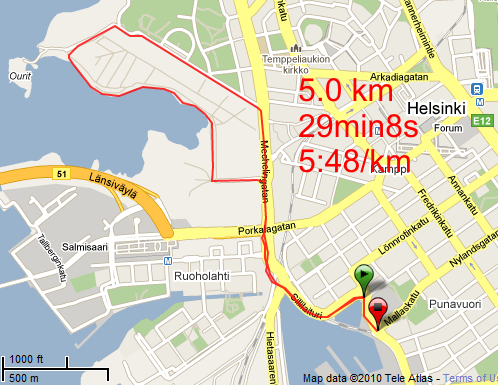
A 2 hour half-marathon corresponds to a steady 5:41/km pace, so it's "only" a bit more than four of these evening runs done one after the other.
Sunday 12k
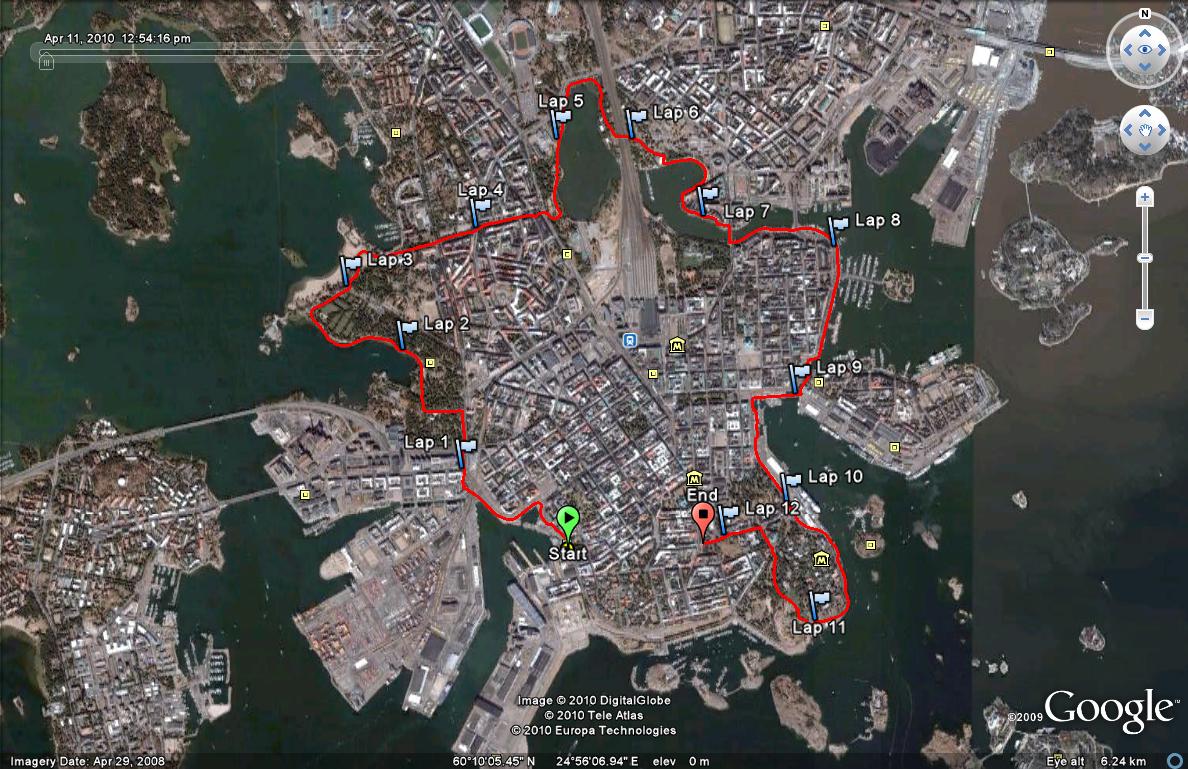
Slow 12k today. Felt fine until about km 7 or 8, then it was more work to get home. I should learn to eat and drink better during the run since takes more than one hour.
Only three weekends, four weeks, until the planned half-marathon. I'll try to do 14k next week, then 16k two weeks before the event, but then probably ease off the week before the half-marathon, which is 21097.5 m long.
Through "micke-midlife's" blog I found a new Finnish running site last week, www.42195.fi
Cutting down the octree
If you number the octants in an octree using a 1982 scheme called Gargantini-code, and store the codes for only the black nodes in the tree in a list then that's called a linear octree.
For quadtrees, there is a 1985 paper by Bauer with an algorithm for computing set-operations (intersection, union, difference) between two trees. Ten years later Jiang corrected a few mistakes and extended this algorithm to octrees. Neither paper is free of misprints, but by looking at both I seem to have arrived at set-operations which work.
Pushing lists with 10 000 or more elements back and forth between C++ and python is not very fast, and I'm now rendering each node (a cube) in a tree as a separate Cube-object in VTK, which isn't very efficient. The video shows depth 6 trees at the end, and here's a screen-capture of a depth 7 tree:
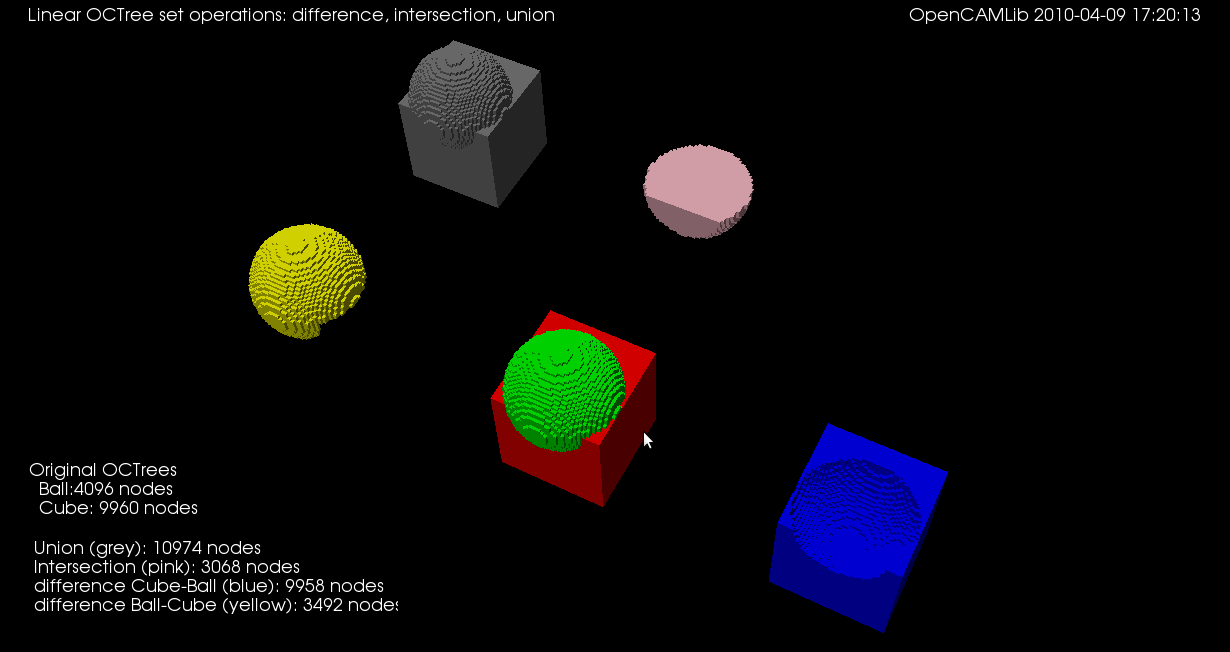
This could be useful for making a cutting-simulator used for both verifying CAM-algorithms in opencamlib, and G-code produced by other programs. It's probably possible to hook into the EMC2interpreter and have it drive the tool in the simulation.
UI FAIL


If you're into that game where you use long sticks to hit a small white ball into a hole in the ground, and would like to hear how Tom Watson, 60, is beating Tiger, head over to the very flashy masters.com.
Now, is the radio supposed to be on when it says "ON" (i.e. "click here to turn ON", or "I'm ON" ?), and the button is yellow and shows a "play"-arrow, or when it says "OFF" (i.e. "click here to turn OFF", or "I'm OFF"?), and the button is yellow and shows a "play"-arrow?
This wouldn't be a problem if there actually was audio at either setting, but having tried Firefox and Chromium under Ubuntu, and then Chrome, Firefox, 64-bit IE (which doesn't have Flash) and 32-bit IE on Windows 7, I still haven't heard any of the radio broadcast 🙁
Why oh why can't they send the radio broadcast over an open protocol so you can listen to it with VLC or some other generic player?
And, dear IBM-engineers, please re-do the radio UI, thanks.
a good servant but a bad master?
Seen on the bus today:
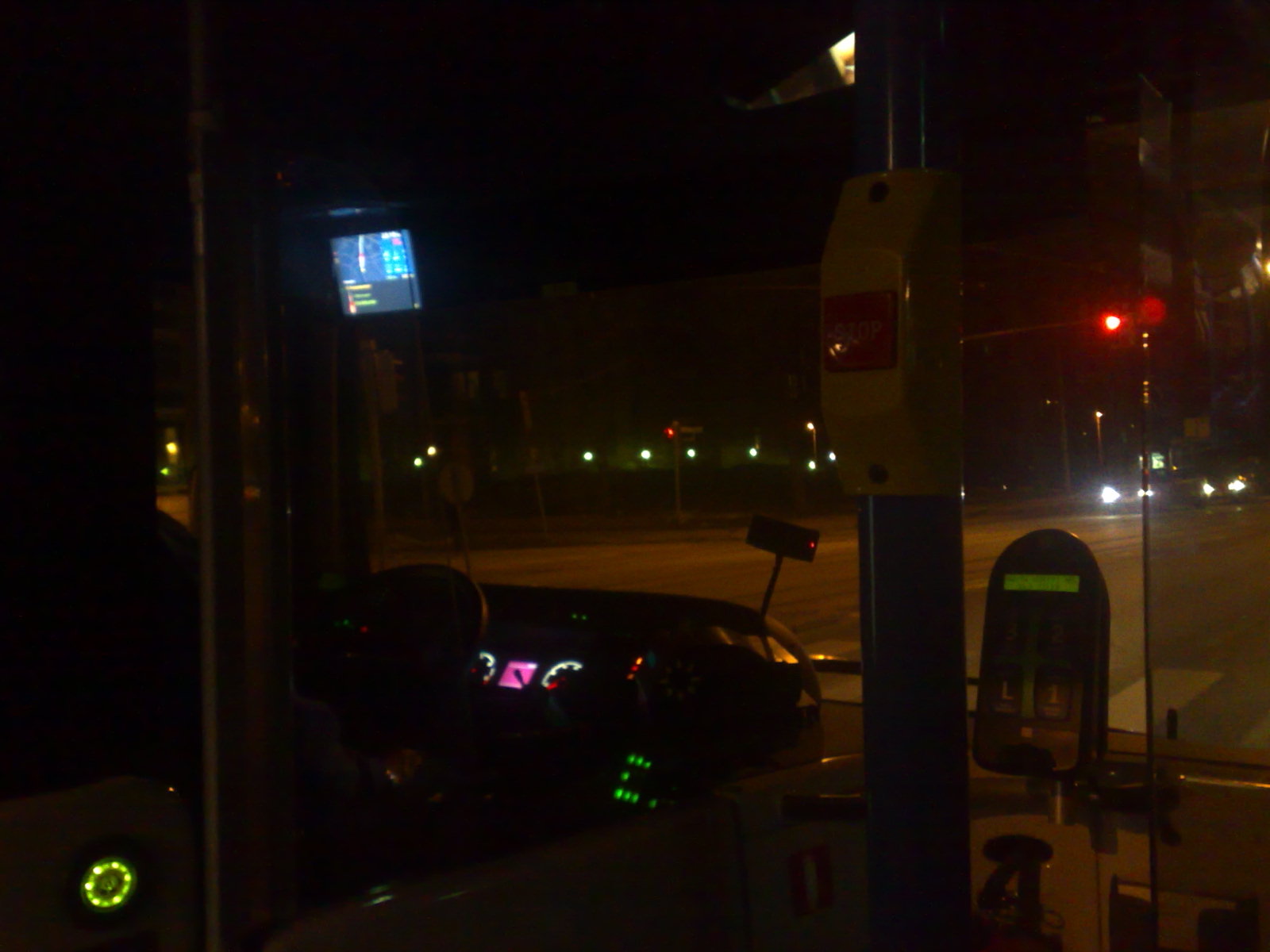
Yep, that's a GPS-screen top left. No need for the driver to know left from right, where the bus is, the route, or think much anything any more.
Back in the Good Old Days if you took a taxi the driver was actually supposed to know where you were going. Not so any more, especially at the airport. Given an address, the driver will probably not know which city or suburb to go to. After you write down your address on a piece of paper (been there, done that), since the driver speaks neither of our domestic languages, the journey proceeds exactly along the GPS trail. If they do the same with buses, install satellite-navigation everywhere, will it be good or bad?
How long before someone drives a bus into the water or off a cliff?
Links - 2010 Apr 8
- The Design of Design -
- The Large Binocular Telescope -
- Hell -
- Efficient tool path planning for 5-axis flank milling of ruled surfaces using ant colony system algorithms -
- Lenovo ThinkPad T410i with Core i3 now shipping -
- iPad Review -
- Three Monitors For Every User -
- End of Gene Patents Will Help Patients, Force Companies to Change -
- Canon EOS Rebel T2i Review – DPReview -
Thumbwheels
M4 thumb-wheels in aluminium for the mast-ram on the model yacht.
Toroidal drop-cutter
A one-triangle test of drop-cutter for toroidal tools (a.k.a. filleted-endmills, or bull-nose).
The blue points are contacts with the facet, and the green points are contacts with the vertices. These are easy.
The edges-contacts (red-points) are a bit more involved, and are done with the offset-ellipse solver presented earlier here(the initial geometry) and here(offset-ellipse construction) and here(convergence of the solver) and here(toroid-line intesection animation).
Mast partner machining
This fork-shaped aluminium part sits in the groove of the foredeck of the PIKANTO. It supports the mast sideways, the M3 threaded hole is for a mast-rake adjustment screw, and the forward hole is for an acetal jib-sheet lead.