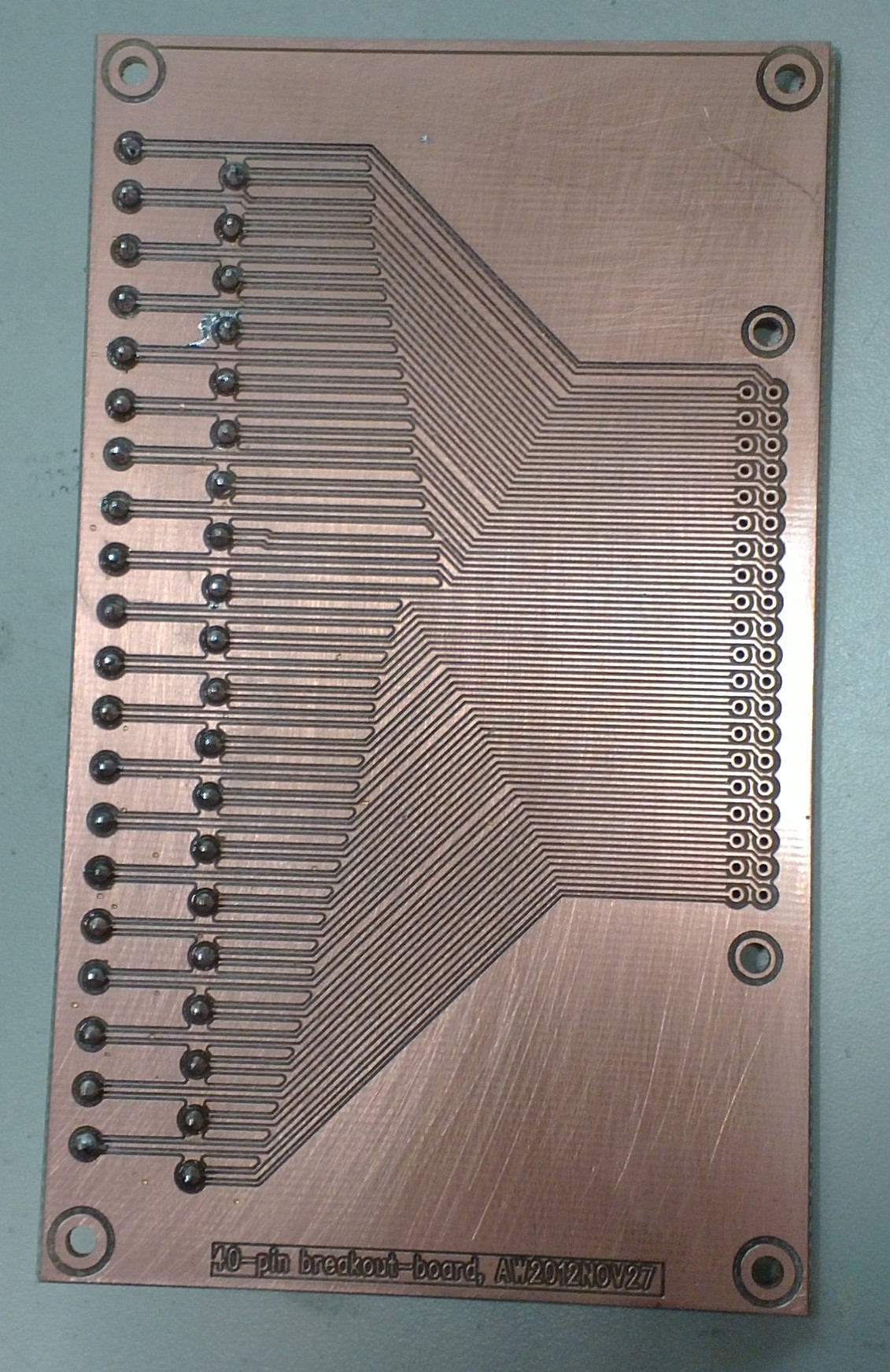
Making break-out boards is not exactly rocket science... Oh well, this one is required for a 10-channel temperature measurement which we do with pt100 sensors and a 4-wire multimeter. It's great however to have a working toolchain where you come up with an idea in the morning, spend a few hours designing the schematic and PCB, then go over to the PCB-mill and run the CAM-programs to produce the PCB, and assemble and test your circuit by the end of the day.
Raspberry Pi
Out of curiosity and with a couple of different projects in mind I have been playing with a Raspberry Pi (a cheap, small, but slow linux computer) lately. Some observations:
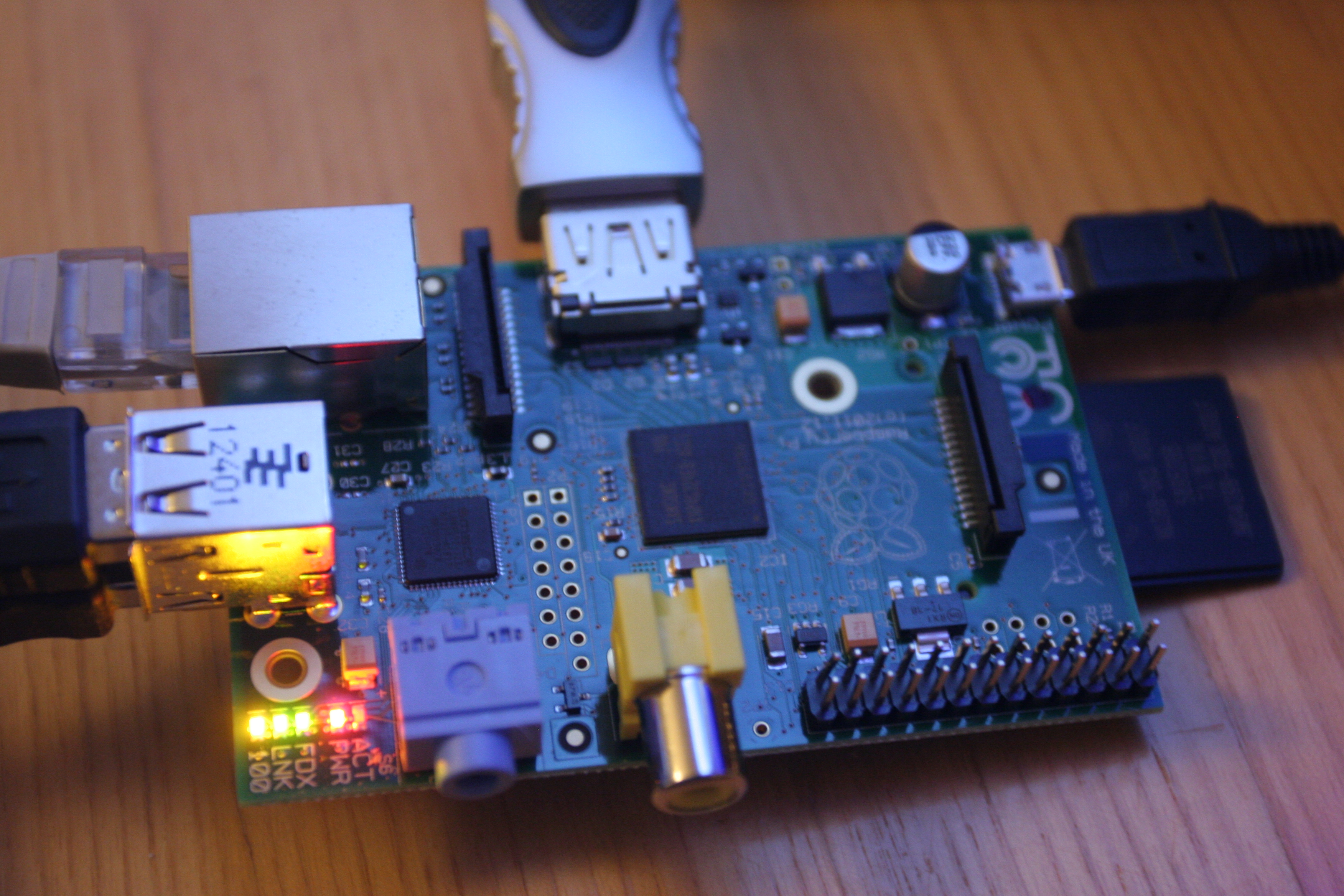
- It's small, but it does require quite a few bulky connectors that connect to three different sides of the board. If you wanted to enclose the board and cables in a case the connectors add a significant amount to the footprint.
- Who came up with the idea of offsetting the two USB-connectors so they extend out of the board? This makes all the cases for the Pi have a funny shape to get the Ethernet and USB connectors flush with the side of the case.
- It seems to run the raspbian distribution OK. But for a standard debian-desktop it's very slow. There are optimized lightweight X-environments that are supposedly faster and more responsive.
- Since it's an ARM processor, not every package I am used to using on Ubuntu/Debian is available from the repositories.
- The modern way to interact with a gadget nowadays is a touchscreen. But there doesn't seem to be any good consensus on what touchscreen to use with the Pi. Could we have something budget-priced with good existing drivers for both screen and touch please. Perhaps use the DSI-connector so the gadget screen won't tie up other resources (USB, HDMI, SPI, or GPIO).
Overall this means my ideas for various real-time instruments & gadgets may be better served by an Atom ITX-sized motherboard. The atom is a standard x86 architecture that runs everything a desktop or laptop will run. It's fast enough to run modern desktop environments. And it has a PCI or PCIE slot for e.g. a Mesa FPGA card. Given the cost of enclosures, (touch)screens, FPGAs, and the analog electronics I have in mind, it really will not matter much if the cost of the motherboard+cpu combo is 40 euros (Pi) or 140 euros (Atom). Someone suggested I'd have a look at BeagleBoard or BeagleBone, but right now I'm leaning towards the Atom.
Espoorastit
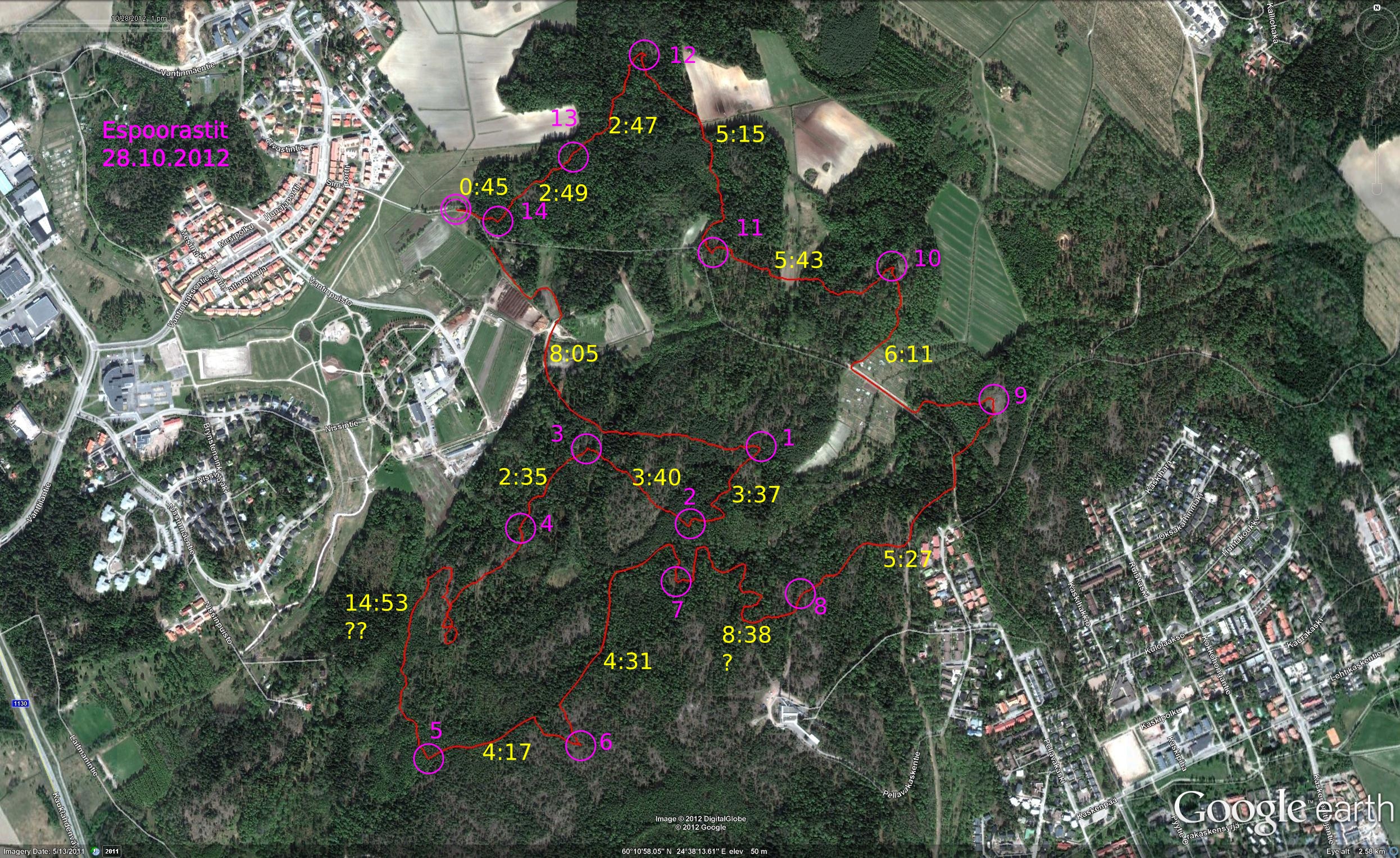
This is the last orienteering event for this year.
On #5 I somehow started looking for the control too early on the wrong hill. Probably lost 10 min here. Then from #7 I went back to a road and tried to find #8 from there when in hindsight it would have been much better to head for the fence around the radio-mast and use that to find #8. Probably another 4 min or so lost. Between #9-#10 my route is too safe and a more direct route through the wet or frozen field would have been faster.
Espoorastit, Uusmäki
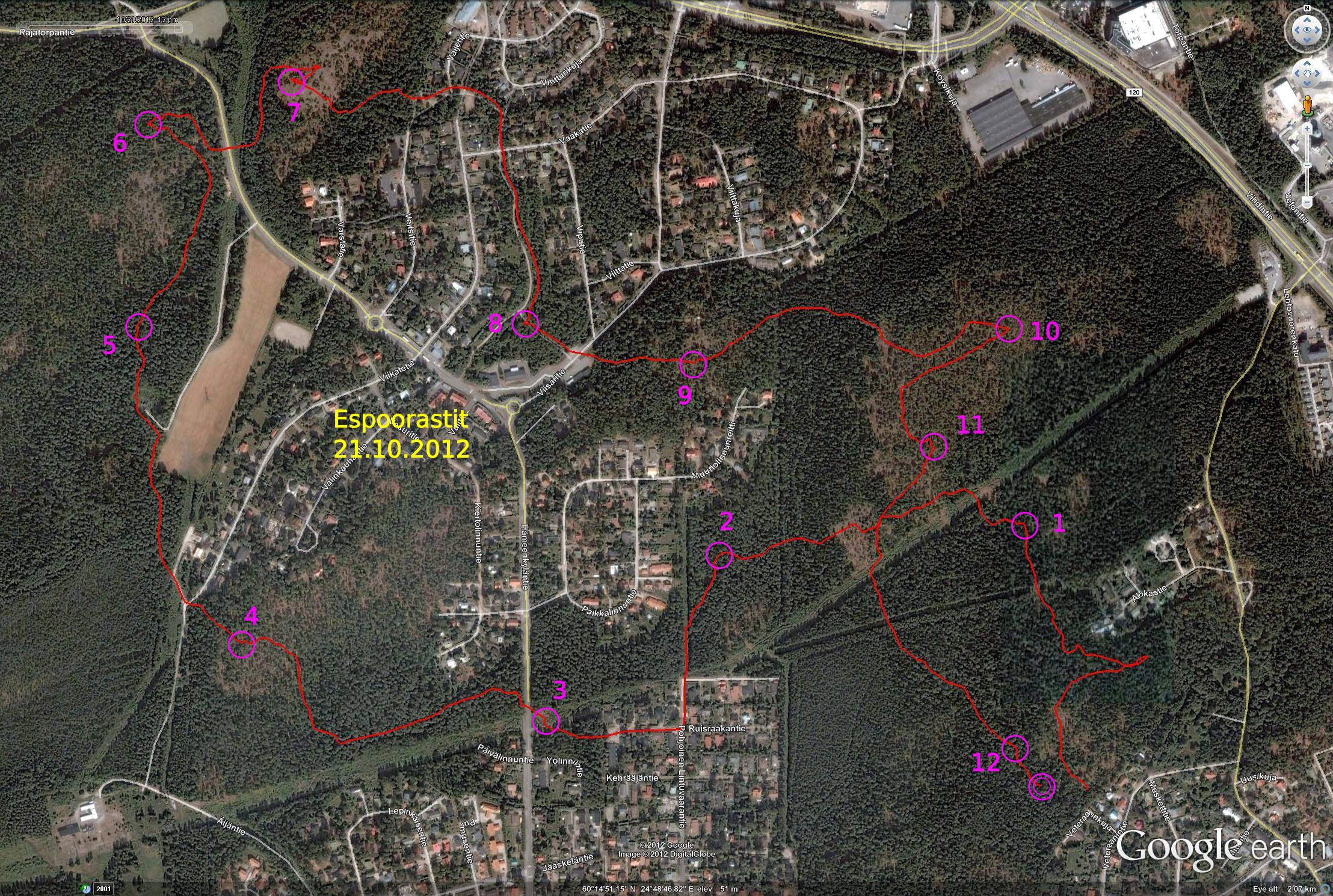
Not a good start as I ran too much east when looking for #1.
Then mostly OK until#7 where I climbed to the top of the hill and had to return half-way down to find the control.
From #10 to #11 the idea was to go directly in the direction of #11, but the execution of that didn't go too well and I ended up walking a while here until I found the control.
5.7km course in 64 minutes.
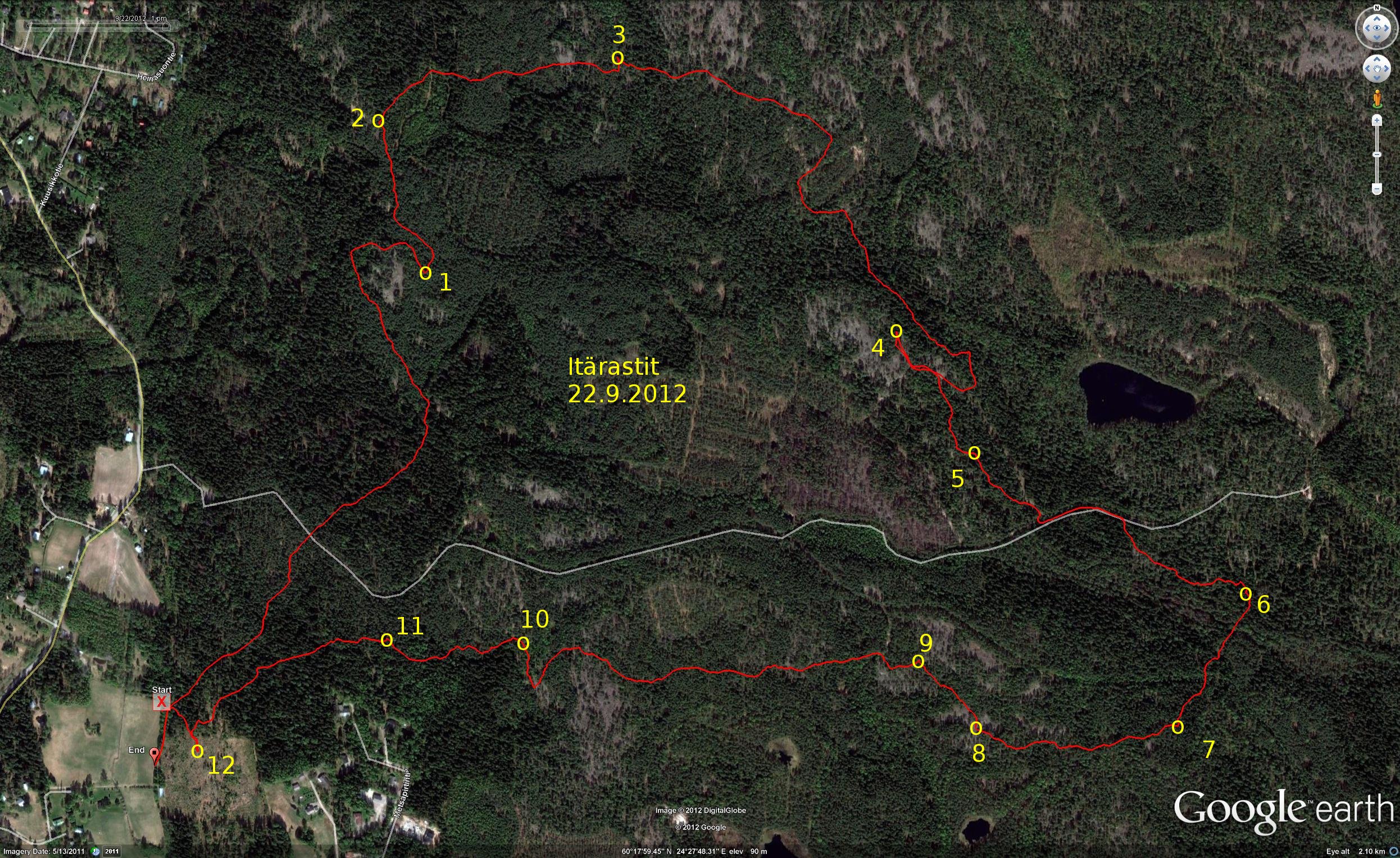
Itärastit, Latokartano
Saturday orienteering again.
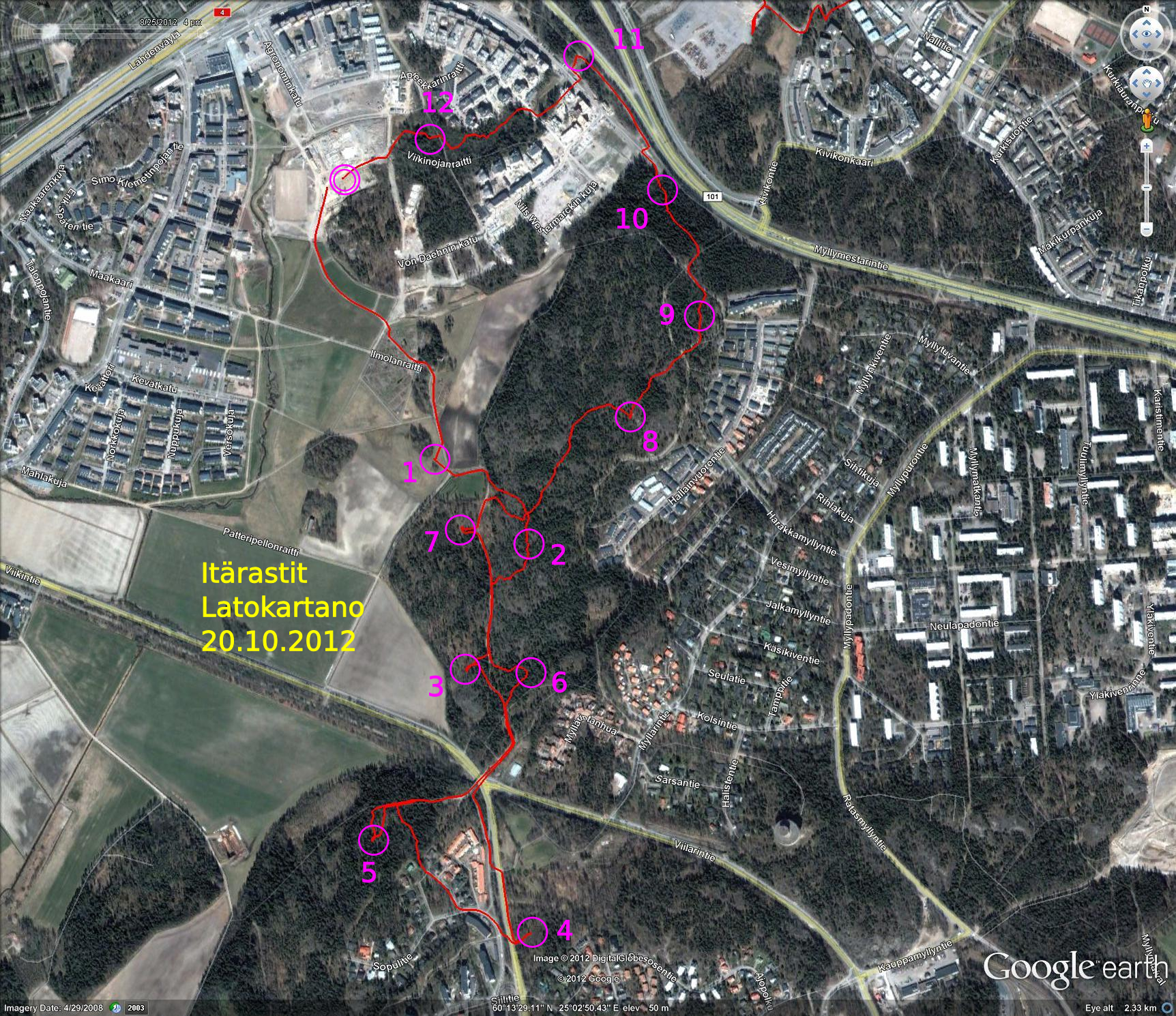
#2 a short but steep hill to climb from #1. Better fitness would not hurt 🙂
#3 and #4 not much to report
#5 biggest mistake of the day as I ran too far to a bigger road, not finding the small path that would have led directly to the control. Maybe 2-3min lost here.
#6 and #7 ok.
#8 again up that steep hill, resulting in not-so-great running speed once on top of the hill towards #8
#9 through #12 and finish were easy. Could have possibly saved time on #12 by running on the road instead of through the woods.
Time 51 min 19 s.
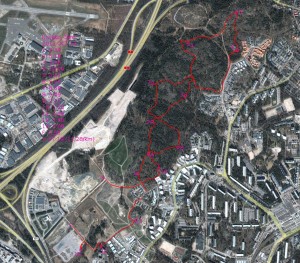
Iltarastit, Stensböle
They have been running the "evening" orienteering events on Sunday midday for a while now, since it is quite dark after 17-18 or so. This is the last event for Iltarastit, but there are a few other clubs organizing these for a couple of weeks still this season.
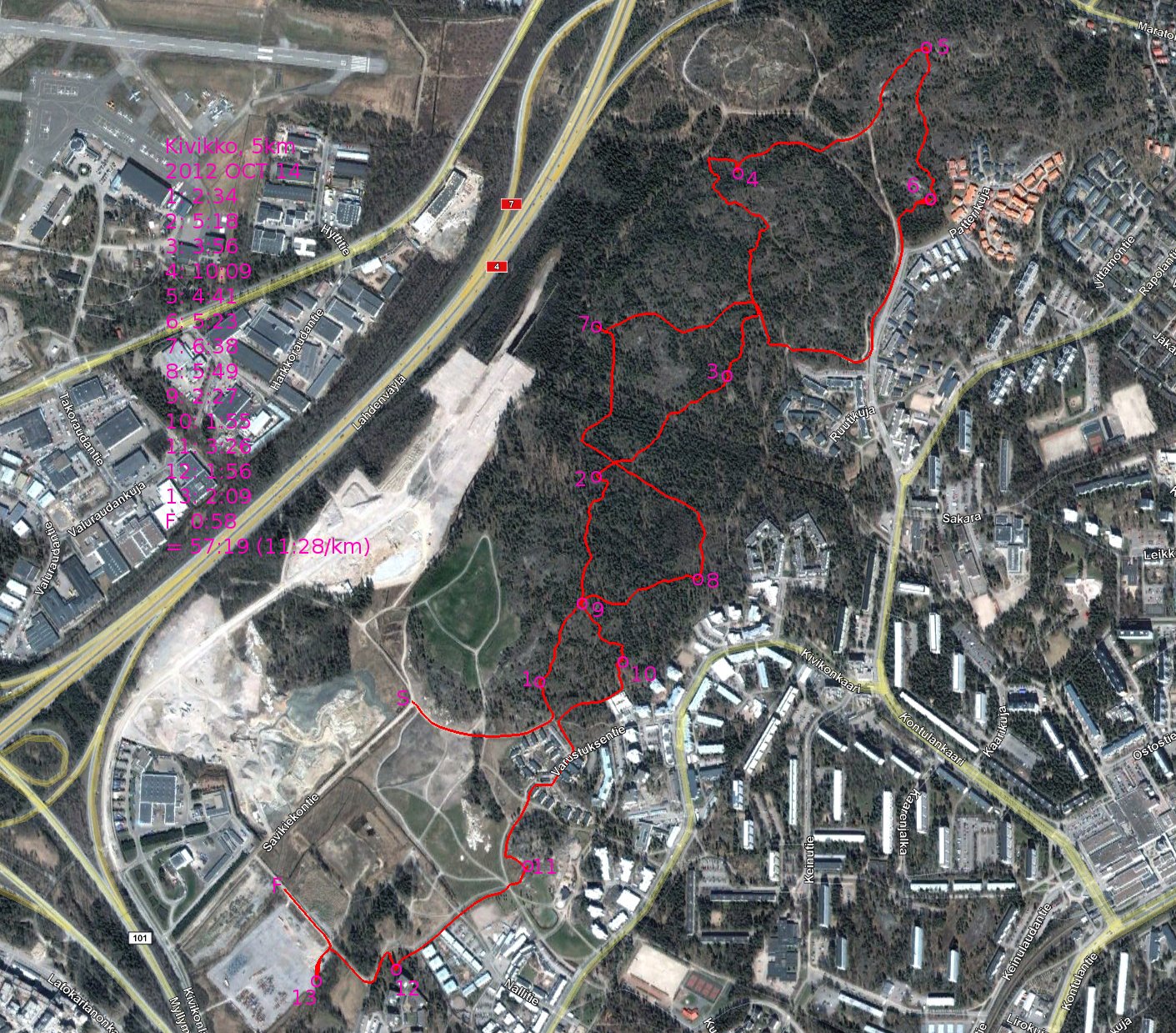
Nothing too dramatic on #1, #2, and #3. Then a lot of deep "canyons" and other steep places around #4 which caused some confusion - probably cost me about 5 minutes here. No problems at #5 but a bit of searching for #6 (not too much lost here, max 1 minute). Then I chose to run not straight, but along paths and roads to #7 - we shall see if that paid off when all the results are up on the web. Again a longer route along a path to #8. From #10 it would probably have been slightly faster to run in-between the houses to the road more directly. Nothing special at #11 and #12. Then #13 was drawn close to a fence, but I didn't really know on which side of the fence the control was - luckily there were others running to/from the control so I just followed them.
This took me about 57 minutes. If I could have avoided the big mistake at #4 and some smaller mistakes the time approaches 50minutes, which is OKish for amateur/fitness orienteering on a 5km course (for me anyway!).
Itärastit, Noux
Tromsö

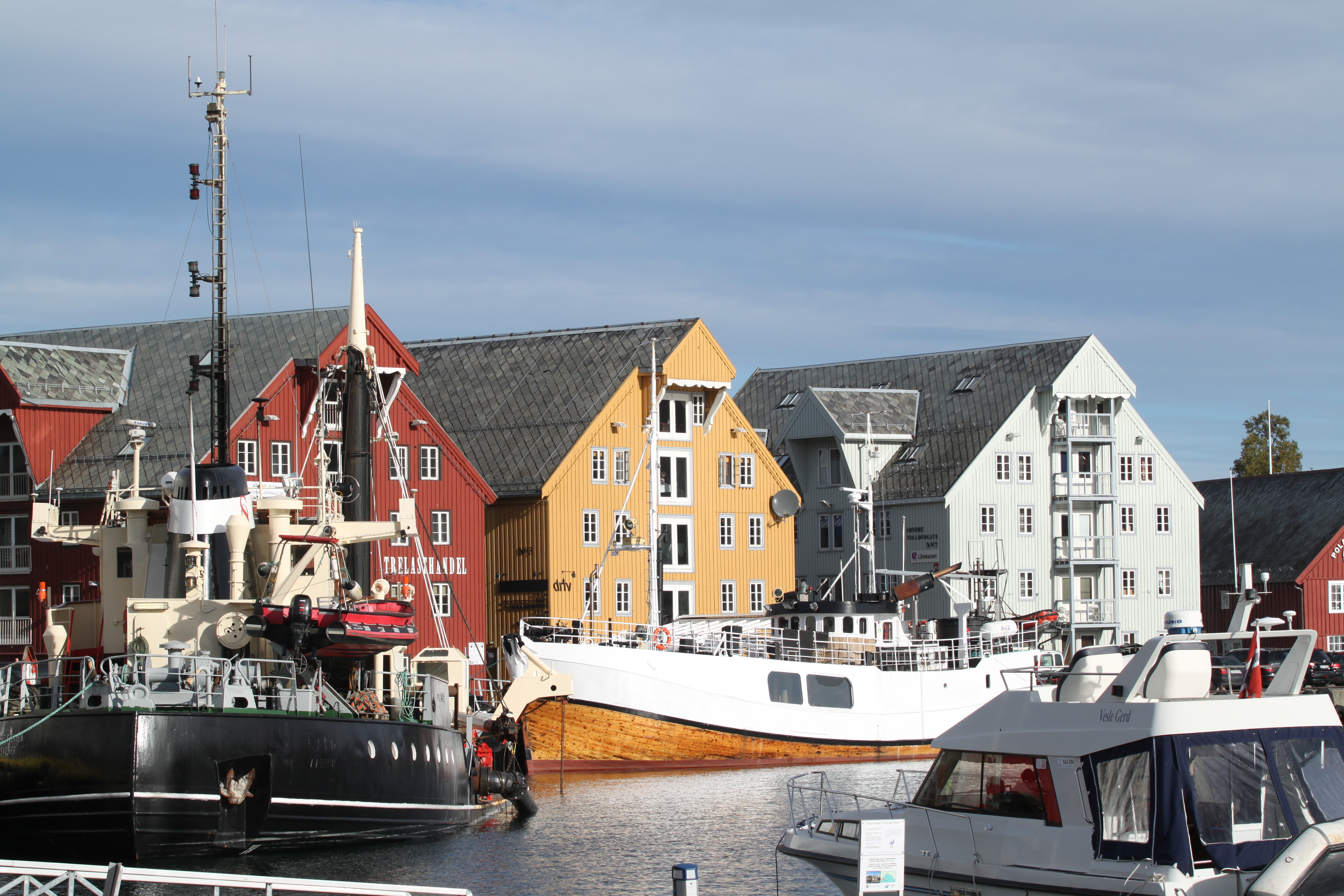
We drove north from Kilpisjärvi around 2 hours to Tromsö today.
More pictures: https://picasaweb.google.com/106188605401091280402/2012_09_14_tromso