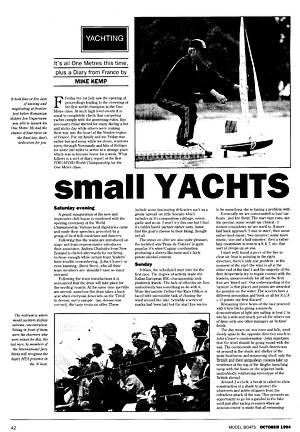
 Mike Kemp offers another report from the 1994 IOM Worlds.
The article originally appeared in the 1994 October issue of Model Boats. Published here with permission. (Link ?? www.modelboats.co.uk seems to be broken ?)
Click image for pdf (ca 1.8 Mb)
Mike Kemp offers another report from the 1994 IOM Worlds.
The article originally appeared in the 1994 October issue of Model Boats. Published here with permission. (Link ?? www.modelboats.co.uk seems to be broken ?)
Click image for pdf (ca 1.8 Mb)
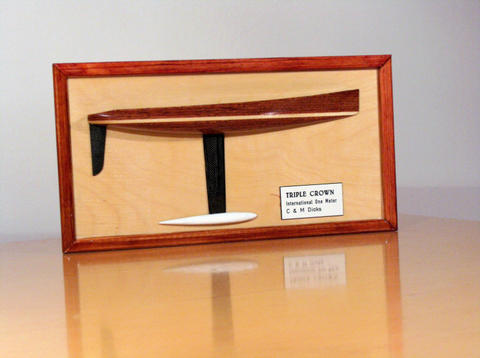
Our unchallenged woodworking guru Olle Martonen who has previously built three wooden IOMs has now produced a half-model in 1:4 scale of the Triple Crown. A similar model that Olle built earlier is used as first price for the Finnish IOM ranking series winner...
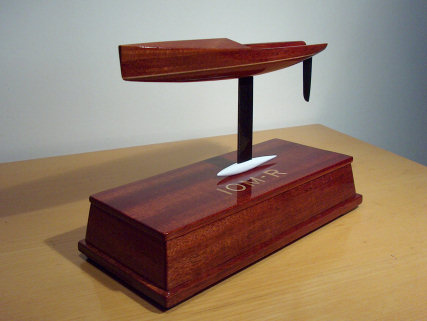
By popular demand, below also a picture of the first 1:4 model:
 Joyce Roberts writes about the 2003 IOM Worlds in Vancouver.
Click image for pdf (< 1 Mb)
Published with permission from Marine Modeling International.
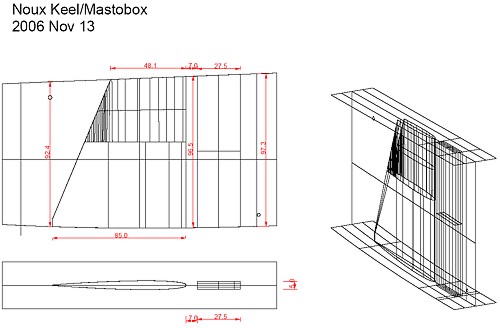
Although we've already built a number of finboxes, I've forgotten to publish the plan - so here it is. As the Noux Mk2 is still somewhat of a prototype this finbox has a long 27.5 x 5 mm slot for the mast which will allow optimisation of the best mast position and rake angle during testing. So as not to carry a whole lot of extra water in the boat we made the mast-box narrow, 5mm, which means that the lower end of the mast needs to be an aluminium extrusion of 5mm width... A future Noux Mk3 might again have a more traditional mastbox for a round mast when we have found the optimal position.
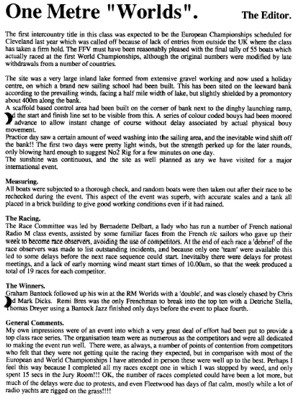
Chris Jackson reports from the 1994 IOM worlds.
Click image for a pdf (< 1 Mb)
Published with permission from Radio Yachting News.
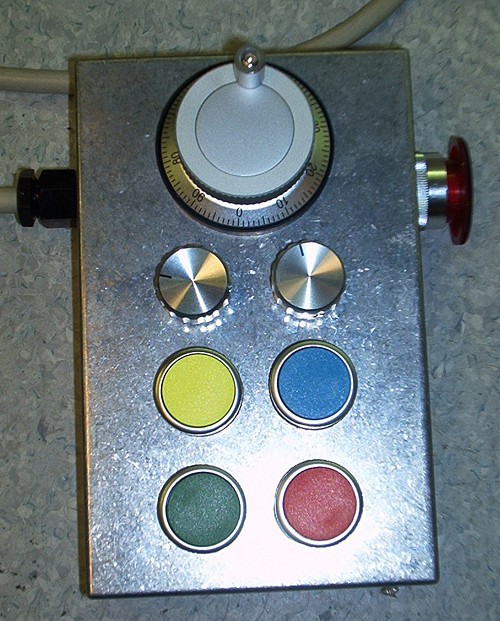
One part of our continuing CNC-mill upgrade is to connect a jog-pendant to the mill which will enable jogging and some other manual controls in EMC2. Here are some pictures and notes of the present status.
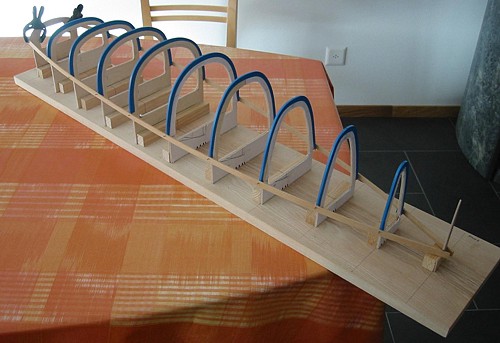
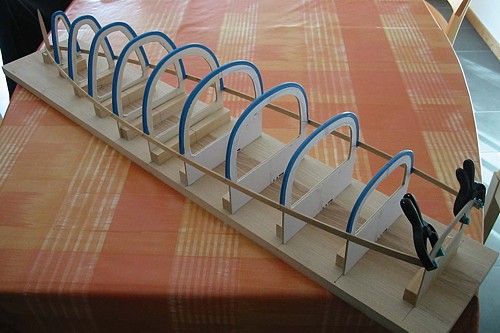
Boris from Switzerland sent me these two pictures of his Noux project which he has just started - thanks !
Rob Guyatt, designer and builder of RMG winches has answered to the challenge from the super-quick arm-winch camp by sourcing a new motor for the RMG280D (the most popular model for an IOM). The motor is about 15% faster than the previous model, while torque is about the same or slightly less.
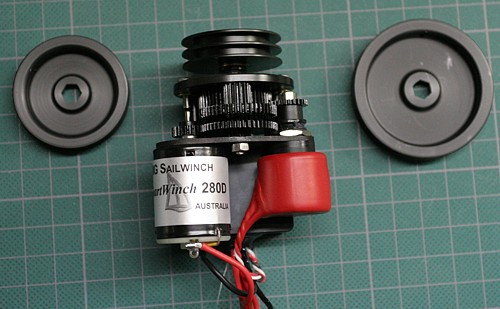
Couple the new faster winch with a bigger diameter drum, which trades torque (force on the sheeting line) for speed, and Rob has been measuring sheeting times, using a typical 310mm travel, which are very similar to what is achieved with an arm-winch. Above the RMG 280D with standard 26 mm drum in the middle, 32mm drum on the left, and 42mm drum on the right.
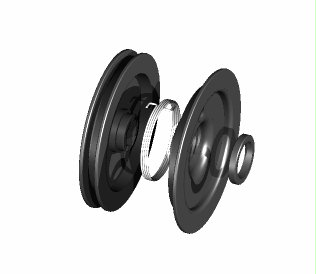
Here's the latest from Rob's drawing board (well, CAD program...). A spring loaded drum ! If I understand correctly one spool of the drum is fixed (and could be a spiral spool), and the sheeting line is connected to this spool. The other spool is spring loaded and will take out any slack in the return line of an 'endless loop' type sheeting system. Especially useful if the sheeting spool is of the spiral type, since the amount of sheeting line travel per revolution is then variable, and the spring loaded spool absorbs this variability.
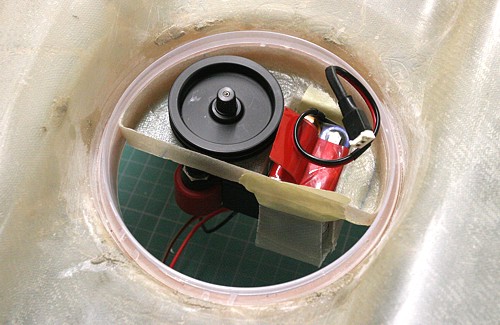
Here the new RMG is sitting in the Noux RC-tray. There's just about room for the largest 42mm drum (flange outer diameter is about 50 mm). There's a thumb-screw on the drum, but it's a bit too high - the lid won't go on like this, so perhaps I'll grind down the thumb screw to about half its height. I've also taped on some supports for the battery, and a 6-cell AA battery fits comfortably. The idea for the rudder servo is that it will hang in an L-shaped bracket from the vertical wall of the RC-tray, final design and wether it will be stiff enough is still to be confirmed.
Update 2007Feb14: Rob has now finalized the design of the spring-loaded drum design and is offering it for sale at www.rmgsw.comÂ
Jari sent me some pictures of tiller arms that he machined during the weekend.
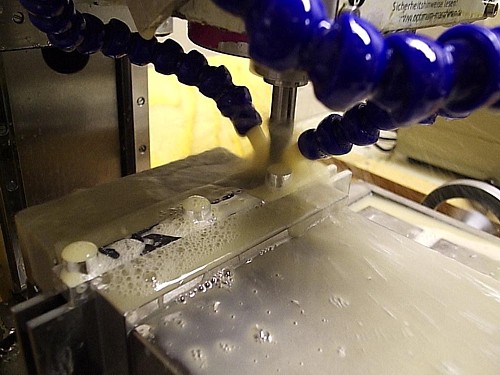
These parts need to be machined in three separate stages, here's stage 1 where the tillers are first roughed and then finish milled.
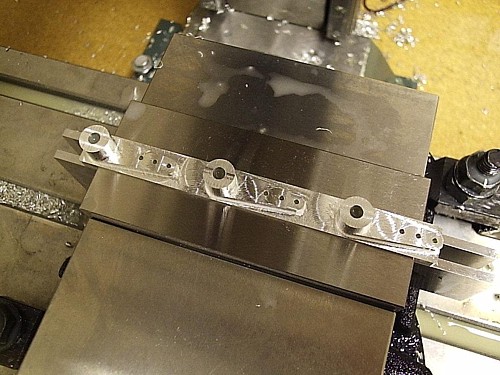
Here's what the parts look like after the first stage. After finishing the hole for the axle and three holes for the push-rod are drilled. In stage two the parts are turned 90 degrees and fixed using a jig. A hole can then be drilled and tapped for a set-screw that will tighten against the rudder axle.
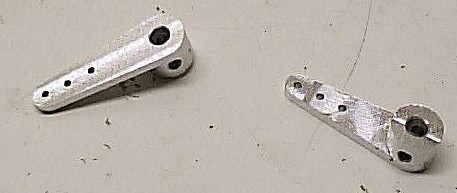
In stage three the whole thing is flipped over and the bottom of the stock material is machined off, which results in these completed parts.
These are still prototypes, for the Noux Mk2 I'd like to see two things: (1) assembly of the boat without tools, i.e. the attachment of the tiller arm to the rudder axle should not require any special tools (allen key, screw driver, etc.). This could be achieved with the current design simply by using a screw with a thumwheel. (2) a fixed relative position between tiller and rudder axle, i.e. when I attach the rudder I want to be sure it sits straight without having to check it everytime and possibly re-trim on the transmitter. A low-tech solution is to file or grind a flat part on the rudder axle onto which the set-screw pushes. If anyone has better ideas I'd be glad to hear about them !
Update 2006 Dec 05:
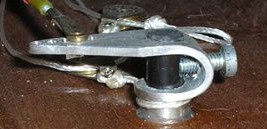
Johan Prak from the Netherlands sent me a picture of his homemade rudder fitting. A very simple design that anyone can make:
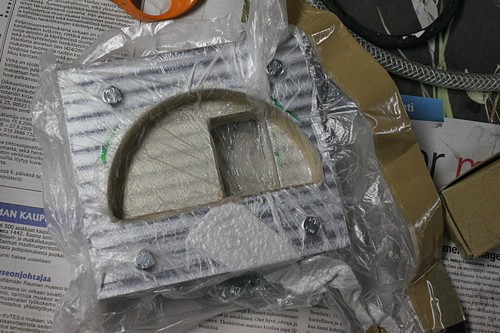
This is the shape and placement I finally settled on. Above is the mould, cnc milled from two 15mm thick pieces of aluminium bolted together. Very similarly to Craig Smiths Obsession I am going to mount the RMG winch on one side, and have a compartment for the battery on the other side. This is not the conventional way to do vacuum moulding, here I'm using only a bag, normally the laminate is followed by a release film, and the a breather (white fabric above), but I find all of this too complicated for small parts. Using just the bag works almost as well, an improvement is to use more of the breather around the laminate so the pressure spreads a bit more evenly. Vacuum bagging need not be high tech: the bag is a plastic bag used for selling fruit in a supremarket, and our pump is an old refridgerator compressor I got second-hand from a repair shop for about 5 eur...
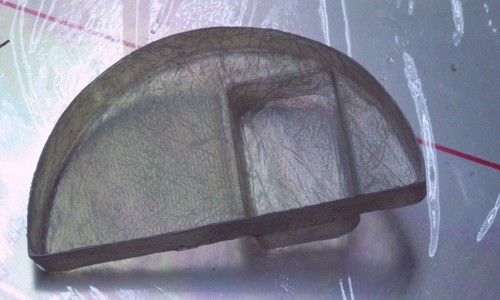
Here's the finished part. Surprisingly stiff with three layers of 165g twill weave glassfiber - it must be all the shapes and angles that does it. Moulded with a vacuum bag (above) to ensure that the fibers follow all the 90-degree bends a bit better. In the picture the bottom of the battery compartment is still in place - the bottom will obviosly have to come off and I will fit some other support for the battery which is about 50mm deep. I didn't want to mould something that was a 50mm deep hole in one go, this part is hard enough to release from the mould as it is.
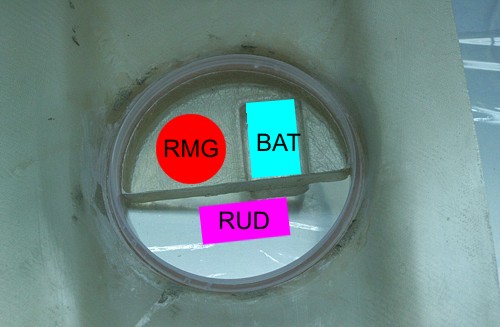
This is what the RC-tray looks like when mounted in the boat. Here we have first the pot-recess which is moulded into the aft-deck. Into that recess the rim of the rc-pot is pressed, and the rc-tray laminate fits into the pot-rim. I've indicated using colors and text approximately how the components are going to be installed. The tray will be fixed to the rim and deck using three M3 screws, which will thread into rivet-nuts that are epoxied to the aft-deck. The rudder servo will require its own mounting bracket - that's next on the design/build to-do list.