Archive for the ‘Research’ Category

Stretching DNA

Saturday, November 17th, 2007

jumpcut movie:DNA stretching

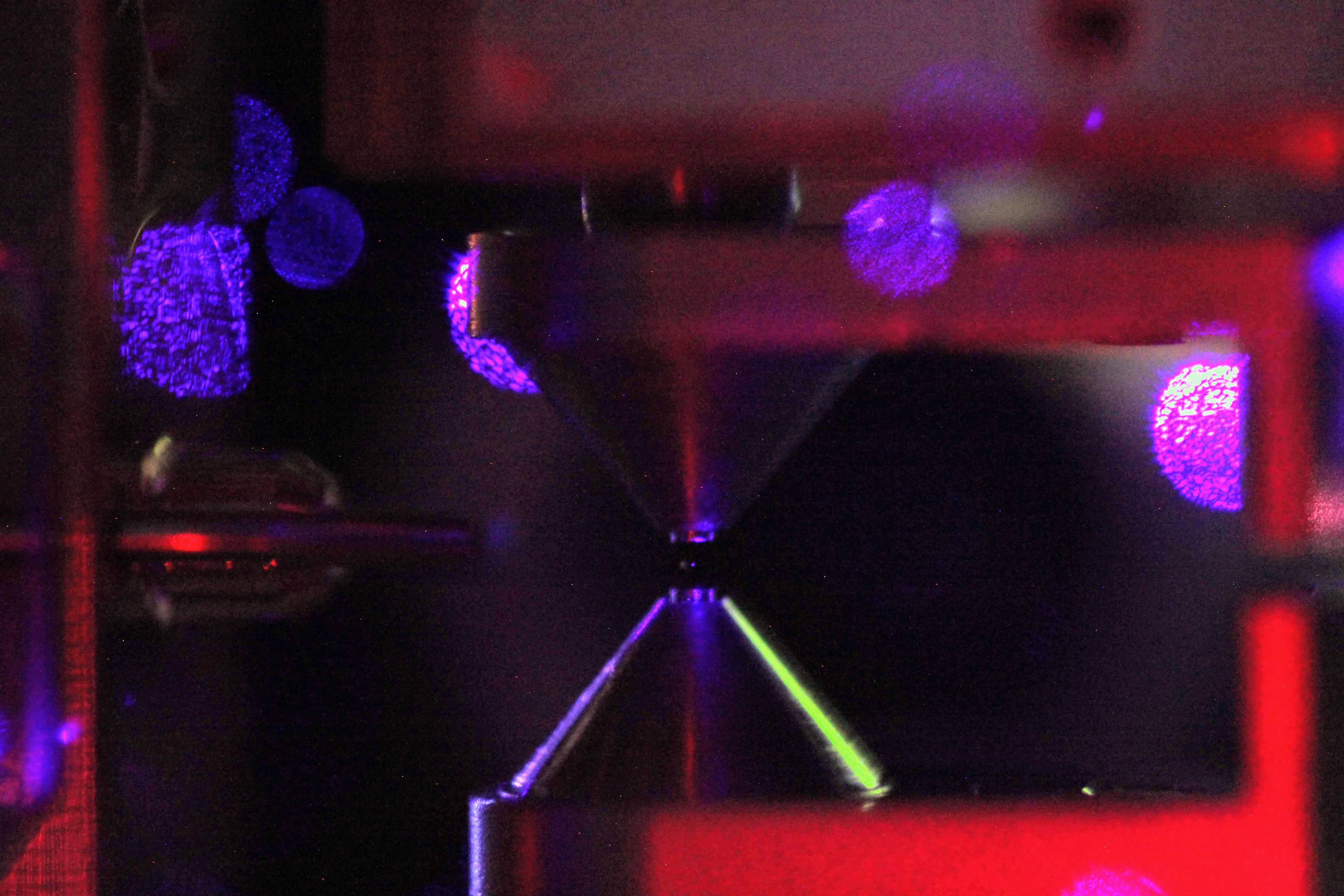
Some promising results yesterday with trying to stretch DNA molecules. The molecule is attached between two microspheres, and we are actively moving the smaller sphere while the force acting on the bigger sphere is being measured. The image and video shows the view through a 100x microscope objective on the optical tweezers instrument I am building. Towards the end you can see the construct breaking in two stages, so that probably means there were two molecules of DNA between the beads and not one as intended. This is a control experiment and will hopefully set the stage for bigger and better things to come…

On SNR in single molecule experiments

Wednesday, August 1st, 2007

ResearchBlogging.org

Wallin, A.E., Salmi, A., Tuma, R. (2007). Step Length Measurement–Theory and Simulation for Tethered Bead Constant-Force Single Molecule Assay. Biophysical Journal, 93(3), 795-805. DOI: 10.1529/biophysj.106.097915

A lot of single molecule experiments are carried out in the configuration shown above. The idea is to mechanically probe a bio-molecule (such as DNA or RNA) or find out how an enzyme (such as RNAP) or a molecular motor (e.g. viral packaging motor) works. You either optically or magnetically trap a microsphere (the round thing with diameter d), which allows you to move it around, measure its position very accurately, and measure the forces acting on the sphere. The sphere is a big thing, usually 500 to 1000 nm in diameter, so it’s easily visible in the microscope (the molecules themselves are not visible unless you label them with fluorescent tags).

Then you ask a biochemist in your lab to bind some useful stuff to the sphere. I’ve illustrated a hypothetical experiment where a molecular motor (MM, grey blob) is bound to the sample chamber wall, and the bead is tethered to the motor via a Worm-Like Chain (WLC, thick wavy line, a common model for polymers such as DNA/RNA).

The problem is that these things are tiny! People want to measure single steps for molecular motors, which can be as short as 0.3 nm. At the same time biological things also live at close to room temperature, so both the molecules and the microsphere are affected by random collisions from the solvent molecules.

Now the question is how small steps or changes in the WLC length are really measurable? It’s a bit like going on a walk with your dog: imagine a very flexible string between the dog and yourself. Now if you pull only weakly on the string you can’t expect to feel very much of the individual steps the dog takes, you just follow along smoothly while keeping the force approximately constant. If you really want to feel the individual steps you would use a stiffer string and pull much harder on it(but the dog would not like that…). Previous work such as that by Gittes and Schmidt and Moffitt et al. pretty much agrees that the Signal-to-Noise-Ratio (SNR) should look something like this:

where you’ve used a force to stretch out the WLC (of length L) to an extension xe, the steps you are trying to detect are of size DeltaL, and the stiffness of the WLC is K. In the square root we have gamma (Stokes drag coefficient on the bead), Boltzmann’s constant kb, temperature T, and f_lp the measurement bandwidth.

What do we need to do to get a high SNR (and thus measure short steps accurately) ? Use a large force (that increases xe and K), use small beads (that decreases gamma), cool down the lab (decrease T, but not so much so that your biology dies!), and measure slow moving stuff (low f_lp). But this formula is not so practical to use. You need to work out the extension xe yourself and also estimate the stiffness K somehow. I couldn’t find anyone who had addressed how this works for common tethers such as DNA and RNA.

My (small) contribution to these thoughts is mainly working out how the SNR really depends on the properties of the WLC and the pulling force. I did a bit of simple theoretical analysis and showed with a Monte-Carlo simulation that the theoretical prediction is about right. This results in SNR ‘maps’ in parameter space that hopefully can guide experiments. For example if you suspect that your enzyme has a certain step length and you know your tether properties you can use the map or an approximate formula to work out the force you need to have a chance of measuring individual steps.

AOD Steering

Friday, April 20th, 2007

I’ve worked on steering our Optical Tweezers instrument using Acousto Optical Deflectors. Here’s an example of what it can do. We’re trapping four 1 um silica microspheres in water using a single 1064nm laser that is time shared between the beads (it hops between them at a fast rate). Then we can program the AODs to steer the beads around in whatever patterns we want.

Montpellier, France

Saturday, September 10th, 2005

With a travel grant from the Chancellor I was able to attend the IUPAB & EBSA International Biophysics Congress in Montpellier 27 Aug - 1 Sep 2005.

Here are some pictures from the trip.
(more…)

2005 Biophysical Society Meeting, Long Beach

Tuesday, February 15th, 2005

Our group attended the 2005 Biophysical Society annual meeting in Long Beach, California.
(more…)