Author Archives: admin

Equatorial Wedge - Drawings

By popular demand, drawings for the iOptron MiniTower Equatorial Wedge project I completed in 2010 August-September (see old blog posts: base, top, side, knobs)

Here's how the wedge looks like. It consists of a fixed plate that attaches to the tripod, two fixed side plates that bolt to the bottom plate, and a moving plate that tilts about 10 degrees. The wedge is designed so that the centre of gravity of the MiniTower is positioned straight over the middle of the tripod.

The extra 6mm hole in the side-plates is for an M6 threaded rod through the mount which should provide precise azimuth-adjustment. I did not complete this feature (for example a rotating nut in the fixed plate would be needed).

minitower_wedge

PDF drawings:

Orienteering 1-6.5.2013

Some orienteering maps I haven't had time to post before now.

2013_05_01_myrbacka
1.5.2013 Myrbacka. Overall very good orienteering on a fairly easy course.
#3 lost a few seconds looking for the control at a big stone when in fact it was a hill
#9 should have found a quicker/better route on top of the hill at #5
#11 slow out of #10 since I did not find the path immediately

2013_05_02_olars
2.5.2013 Olars. Again quite good! Maybe slightly harder course.
#1 maybe a bit too careful at the start
#3 very slow close to the control - went for the wrong feature inside the control-circle
#7 did not have very good control/feel for the distance along the #6-#7 path. should have kept up speed better along the path.
#10 amazingly, the huge detour right around the hill resulted in the best leg on this course! Fast running on the road/path, then very carefully into the control which looked hard to find on the map.

2013_05_04_salmenkallio
4.5.2013 Salmenkallio. Ugh - many mistakes (five out of twelve legs) - and they were out of maps so had to use a hand-drawn map.
#3 circling around as I was looking for the control on top of a ridge or at a saddle, when in fact it was much lower down. Wrong interpretation of height contours..
#5 BIG problems. It should have been easy to run along the path and look for the right cliff features on the right and find the control 50m from the path. I managed to climb the hill much too soon and circle around on top of it. Dead last in the split-times! :)
#6 veering off compass course to the right, which resulted in unnecessary distance. Blue line shows a better direction.
#11 somehow I was afraid of the green area and decided to run around it, but made a much bigger loop than necessary. Should have run right through(blue line) the green thick area!

2013_05_06_pirttibacka
6.5.2013, Pirttibacka. This should have been a familiar map... but made bigger mistakes on three out of twelve legs. (numbers refer to the control-codes on the map)
#30 Aaargh! How is it possible to start towards the first control at 90-degrees to the right direction??
#6 wanted to run along the path and find the less steep opening in the hill (blue-line). Didn't run far enough and instead circled around #19
#14 my route is direct but the second half is slow going through an area with many details. The blue line probably shows a route which is easier and more fool-proof to implement.

Crimp Clamp Tool

I've been cranking out parts for this Crimp-Clamp-Tool over the past few days:
(design inspired by Lindsay Wilson's site, which has more information on the seal-off technique)

crimp_clamp

It's used to permanently seal vacuum-systems that are pumped through a ~10 mm diameter copper tube. The jaws of the tool compress the tube and "cold-weld" the tube walls together which seals the tube.

13040021

The top and bottom clamps are milled from 20x40 mm steel bar. The bottom clamp has slots that secure two M12x100 bolts in place, and 6mm holes for M6 screws that hold half inch Thorlabs rods that guide the top and bottom clamps. The top clamp has 12mm holes for the bolts, and half inch holes that I opened up with a boring head so the Thorlabs rods (about 12.66 mm diameter) fit accurately.
13040014

The jaws are 3.125 mm diameter carbide rods (the shaft from old used PCB milling bits). They are held in a V-groove on a rod-holder part that bolts to the top/bottom clamps with M5 screws. I glued the rods to the V-groove with Loctite Hysol.

13040015

Here's how the crimped tubes look like. The first test resulted in a jagged edge, while the second test produced a nice straight cut. We will test how vacuum-tight these are with a Helium sniffer later.

13040022

PDF drawings:

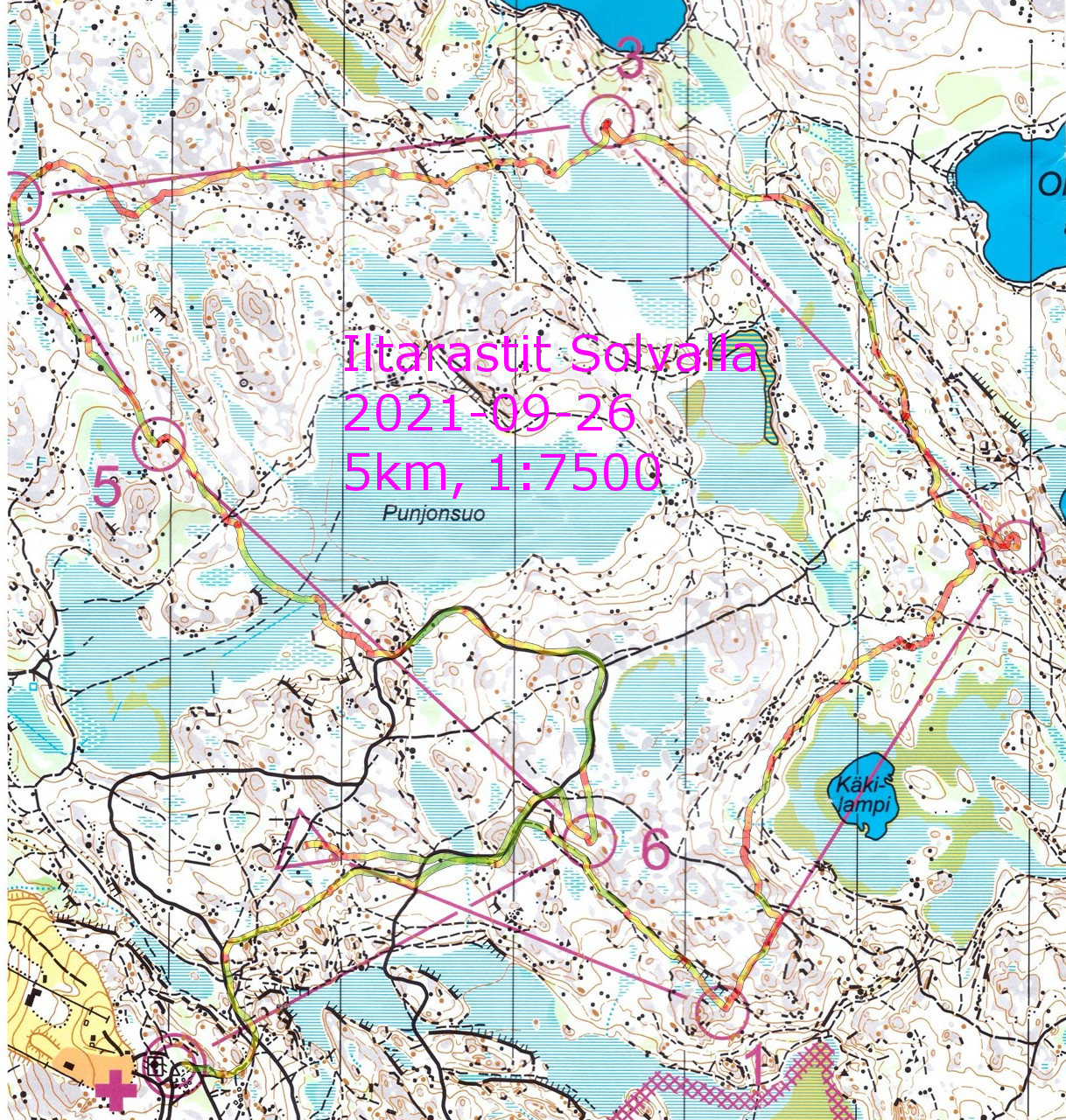
Iltarastit, Luk

#15-#16 a long pause to read the map on top of the first hill
#16-#17 a small correction to the south just before the control
#18 had a reasonable plan and executed it OK.
#19 again a long pause to read the map
#20 found the swamp instead of the lake :(   didn't have a good plan when leaving #19
#21 again poor planning running up/down hills instead of around them.

2013_04_29_luk

Itärastit, Degerö

2013_04_20_degero_qr_splits

A fairly easy course with lots of running along roads and paths.
Right at the beginning on #2 I searched for it on the wrong hill - on the wrong side of the road/path ?!?
#3-#4-#5-#6-#7 nothing to report. Running speed is enough for top-10 placings :)
#8 the GPS-path looks ok but speed was slow.
#9 right after #8 the compass seemed to just rotate around and I wasn't confident enough to run by the map alone. Very slow and shaky going to #9.
#10-#11-#12 more fitness required to keep up speed in the forest and uphills
#13 again an easier control and better speed
#14 lost concentration and headed in the wrong direction. Lots of open areas with freshly cut trees (compare to 2012 map)- hard to tell how well the map corresponded to reality here.

A White Rabbit test

Update3: Here's what happens if you disconnect the master from the switch. The slave clock runs off on its own, with about 5ppm drift compared to the reference clock. Once the fiber is connected again it takes a few seconds to re-sync and lock on to the master clock.

wr_master_kuitu_irti

Update2: two different measurements, on the left with a short 2m fiber, and on the right with a few hundred meters of fiber to a WR-Switch, and a few hundred meters back.

wr_gm_test_csc_2013apr19

Update: an improved measurement now shows some promise:

wr_gm_test_2013apr19

Testing White Rabbit at work. These are fancy network-cards connected by optical fiber which allow synchronization between the cards at better than 1 nanosecond level. My first results are a bit strange:

wr_grandmaster_short_fiber_slave-pps_stats

This is in "grandmaster" mode where we input a 1 PPS and a 10 MHz signal to one of the cards:

13040007

A second result in "free-running" master mode:

WR_freemaster_pps_stats


Iltarastit, Tali

2013_04_08_tali_qr_splits

Still lots of snow on the ground, and a temperature just barely above freezing this evening.

The first red (slow) bit between #19 and #20 could not be avoided - just too much snow for running. A bigger mistake on the #11-#12 leg where clearly the better choice after the bridge would have been to run up the hill. Instead I continued north along the stream looking for the small and steep trail up to the control - which was of course completely covered in snow and invisible. Having not learnt much from this I then sort of repeated the same mistake on #25-#24 where my route is direct, but very slow because of snow up to knee-level or above. A small U-turn on #23-#15, but it probably did not cost much in terms of time lost.

My timing-receipt from the EMIT-system shows strange split-times. We'll see if those are corrected in the final results.