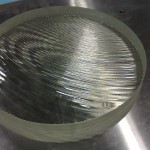
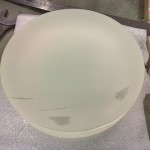
To keep the mirror edge from chipping and breaking we are putting a bevel on it. Most guides tell you to do that with a sharpening stone which is made from carborundum bonded into a stone-like material. I thought doing the bevel by hand with the stone was much too slow, so I tried it with a diamond-bit on a dremel:
This works much faster and a 1-2 mm bevel can be made in a few minutes. After the bevel grinding you see our 'grind-o-matic' machine. It's driven by a 90 W DC motor with a 30:1 gear-head connected to a 12 mm steel axle which supports an aluminium disk on which the mirror or tool sits. There's a sheet of plastic to keep the wood and floor dry.
After about 2 hours of grinding with nr. 60 carborundum we achieved 1 mm of sagitta. A drop of glycerol in the grinding slurry helps to avoid stiction between the mirror and the tool. For a 240 mm diameter F/6 mirror the target sagitta is 2.5 mm so there is still some work to do.