96.3k in 4h 42min, avg. 20.5km/h. New Continental Gator Hardshell 700c 32mm tyres and Bontrager RXL shoes.
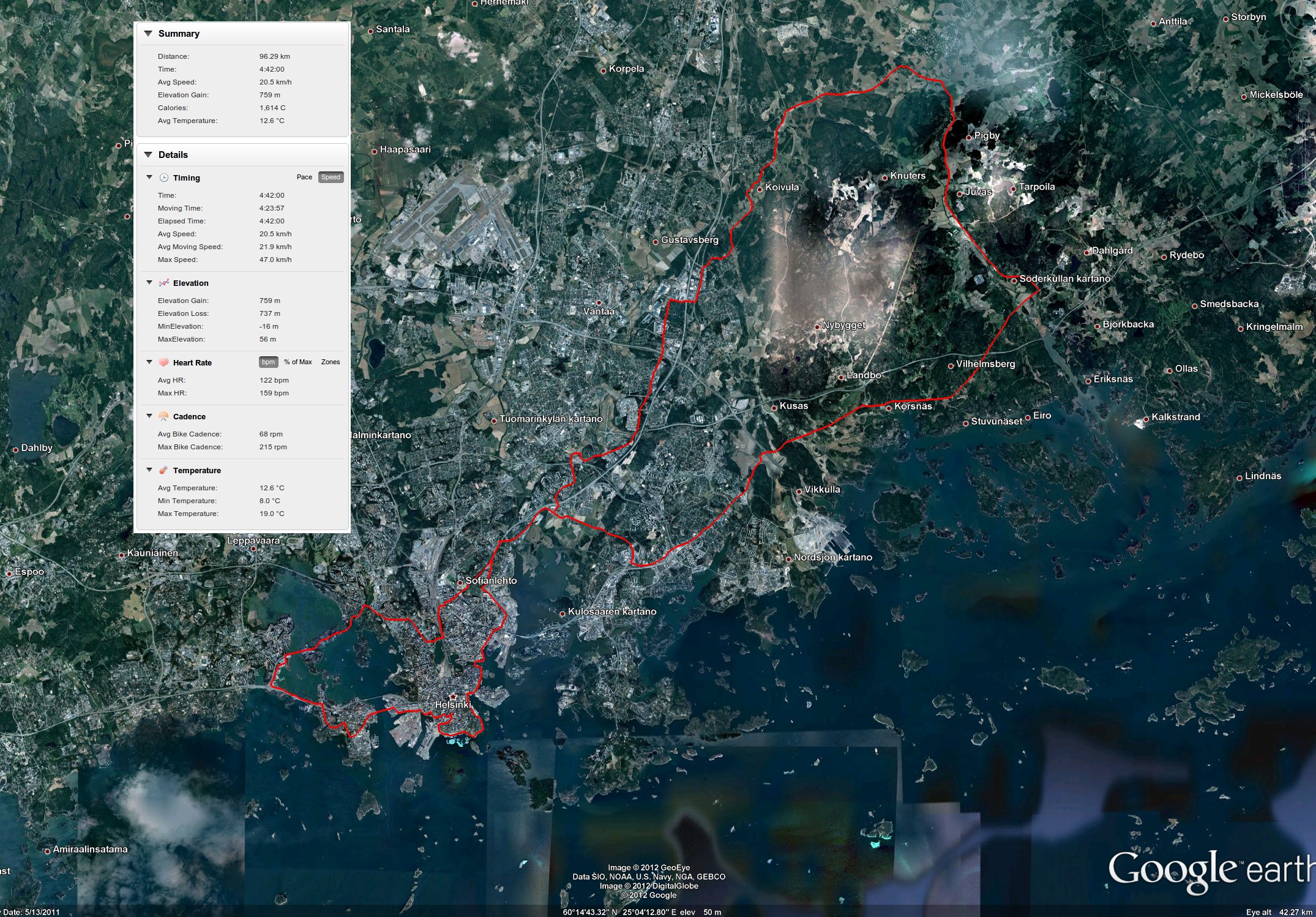
96.3k in 4h 42min, avg. 20.5km/h. New Continental Gator Hardshell 700c 32mm tyres and Bontrager RXL shoes.
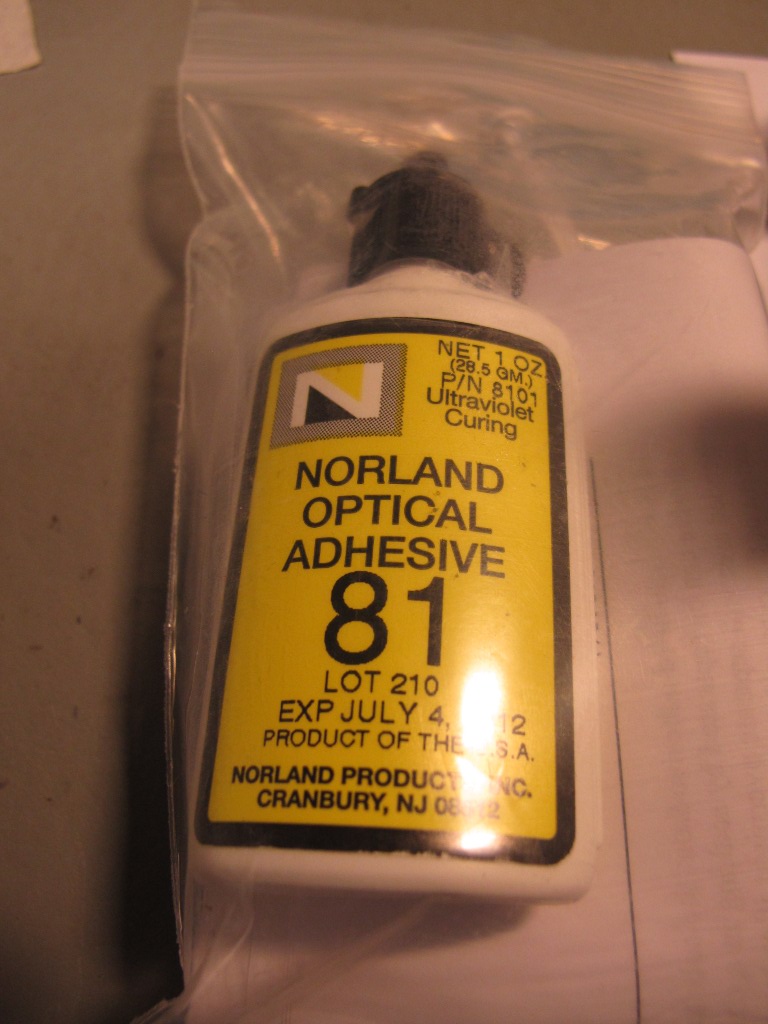
We use Norland Optical Adhesive (NOA-81) for gluing bits and pieces together in the lab. The glue cures in UV-light. So far we've used a fluorescent solarium lamp for this, but we broke one of the two remaining lamps and can't seem to source new ones.
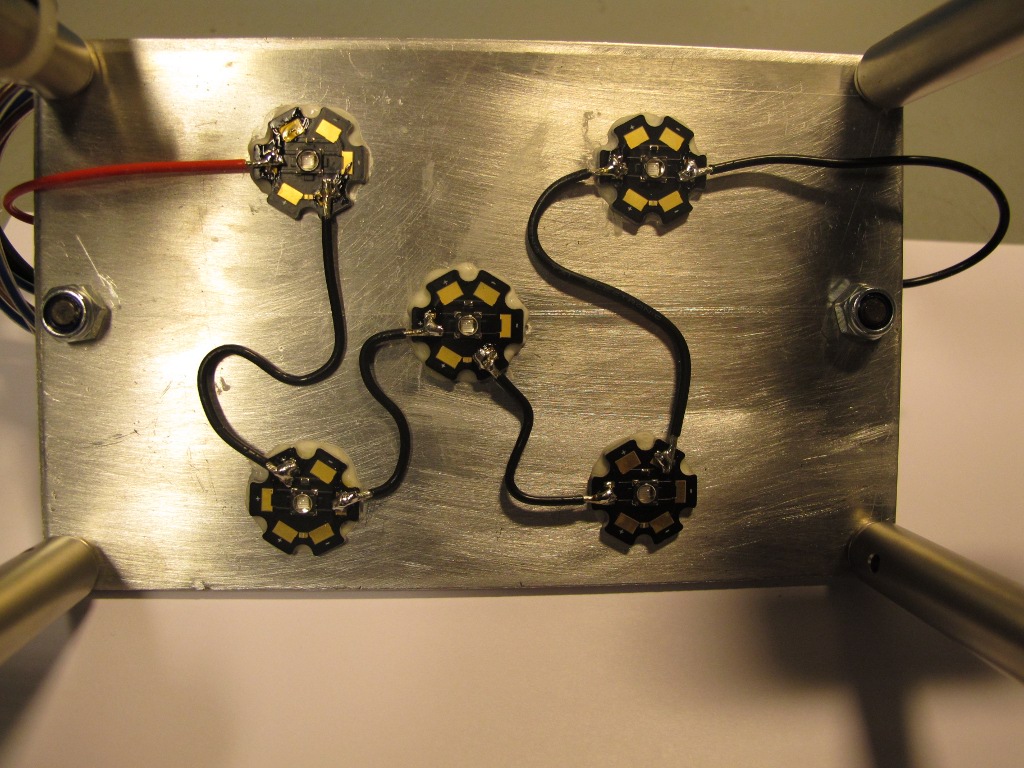
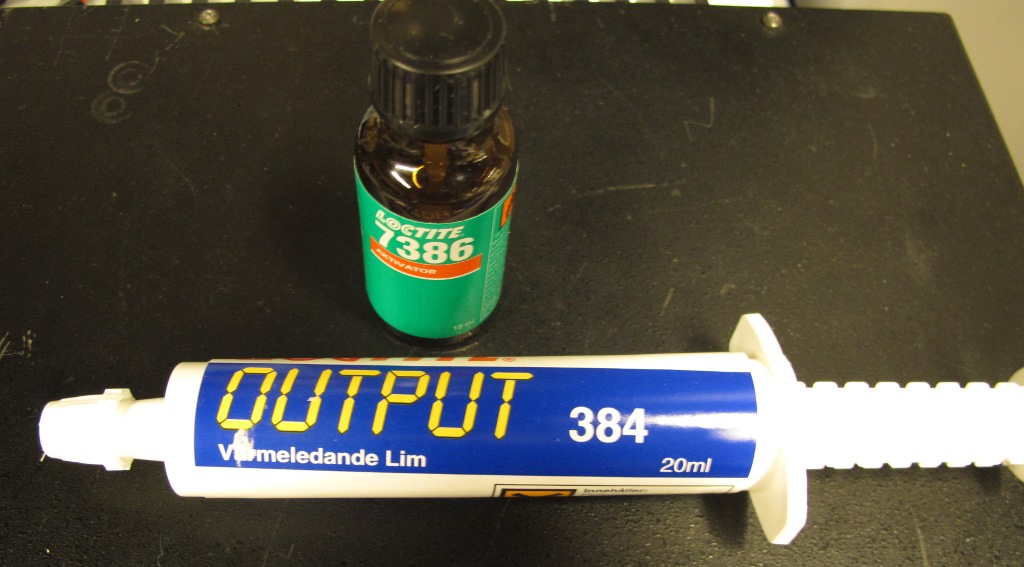
So I decided to try an LED solution. These are LEDEngin LZ1-10U600 LEDs with a center wavelength of 365 nm, 28 euros each from Mouser. They are glued to an aluminium plate using a heat-conducting glue, Loctite Output 384:
For simplicity I used a LighTech 18 W 700 mA constant-current powersupply that runs directly off AC mains. The powersupply has a maximum output voltage of 24 V which is enough to drive the five UV-LEDs in series (the UV-LED has a voltage-drop of 4.1 V)
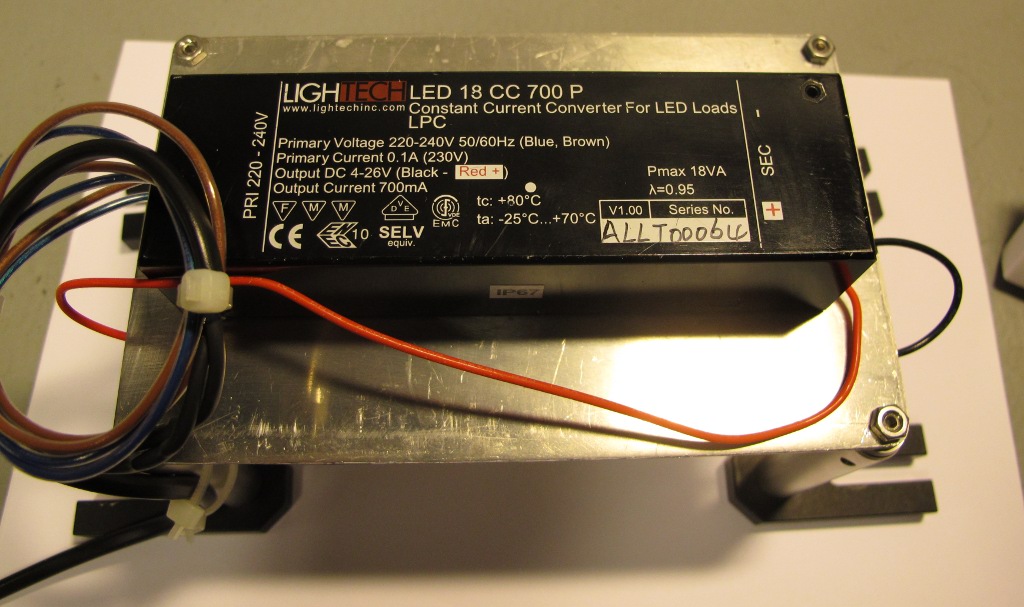
Here's how the lamp looks like:
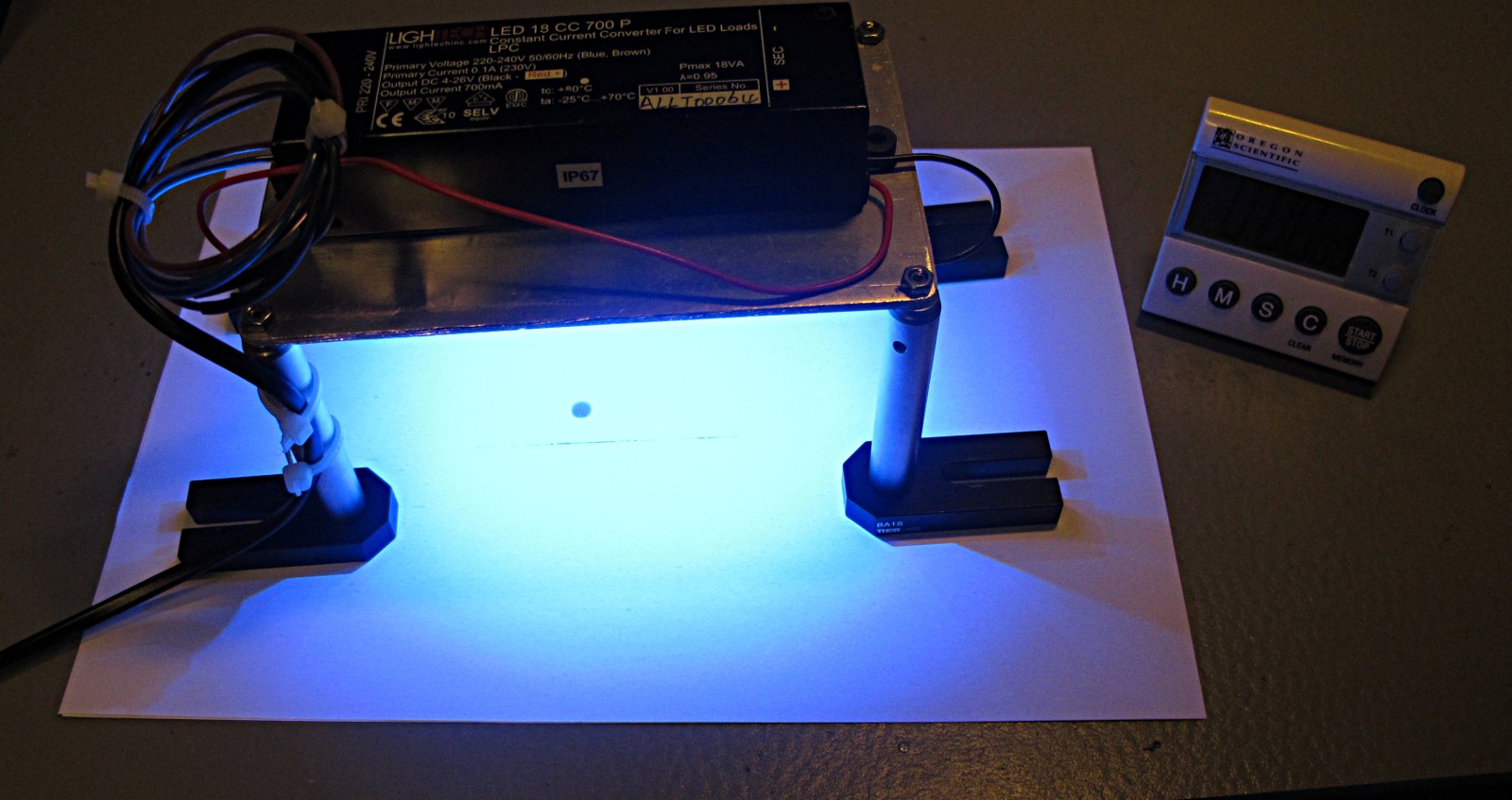
Most of the blue in this picture is fluorescence from the white paper underneath the lamp. A quick test shows that the NOA-81 glue cures very quickly indeed (seconds) with this lamp. Much faster than with the old fluorescent lamp (minutes) anyway. This kind of lamp may be useful for PCB-making also? I didn't keep the lamp on for very long yet, so I don't know how adequate the alu-plate is as a heat-sink.
Warning: The UV-light from these LEDs may be more or less harmful for your eyes and/or skin. Don't try this at home unless you know what you are doing!
70.33 km in 3h 21min, avg. 21.0 km/h
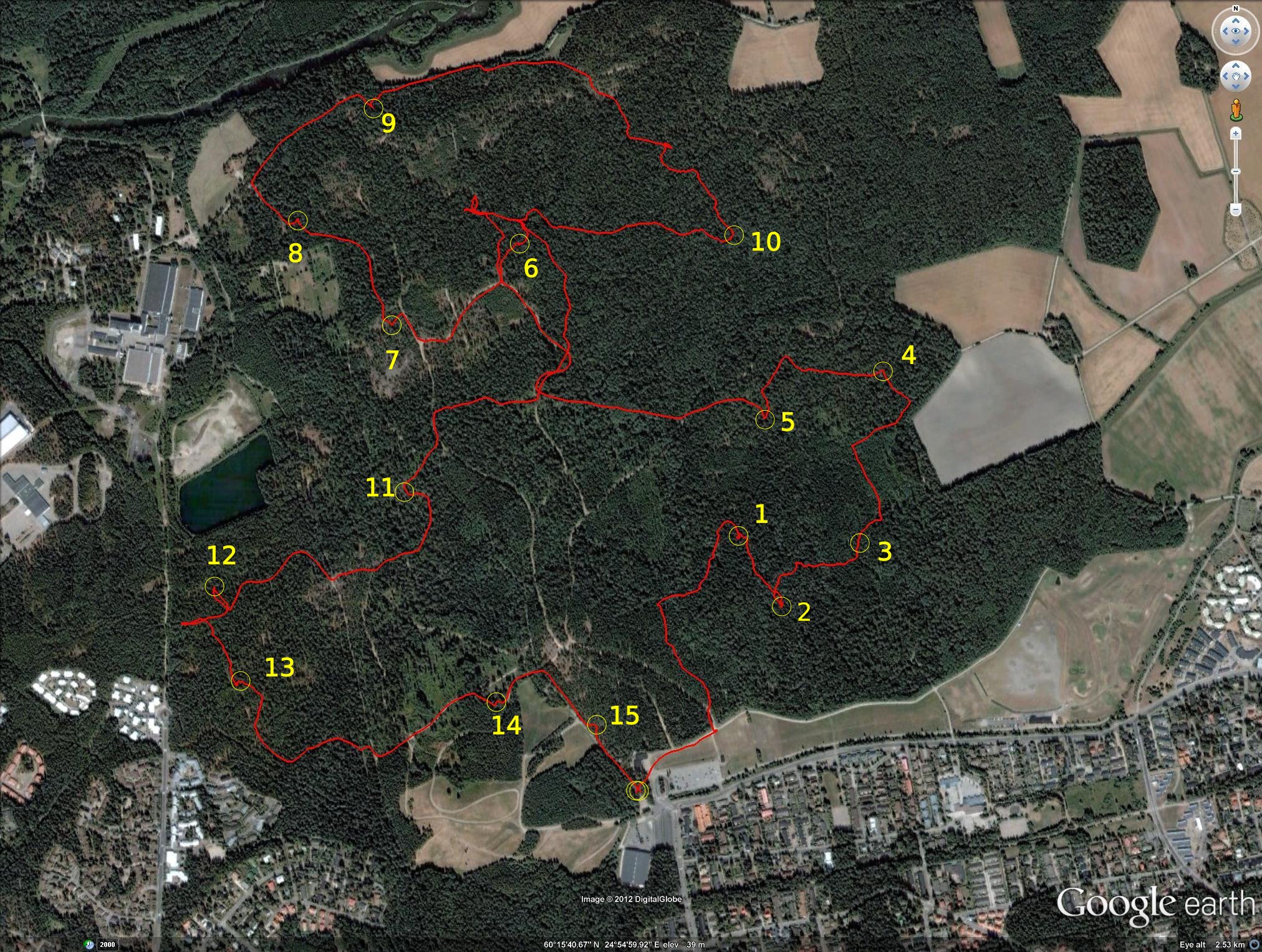
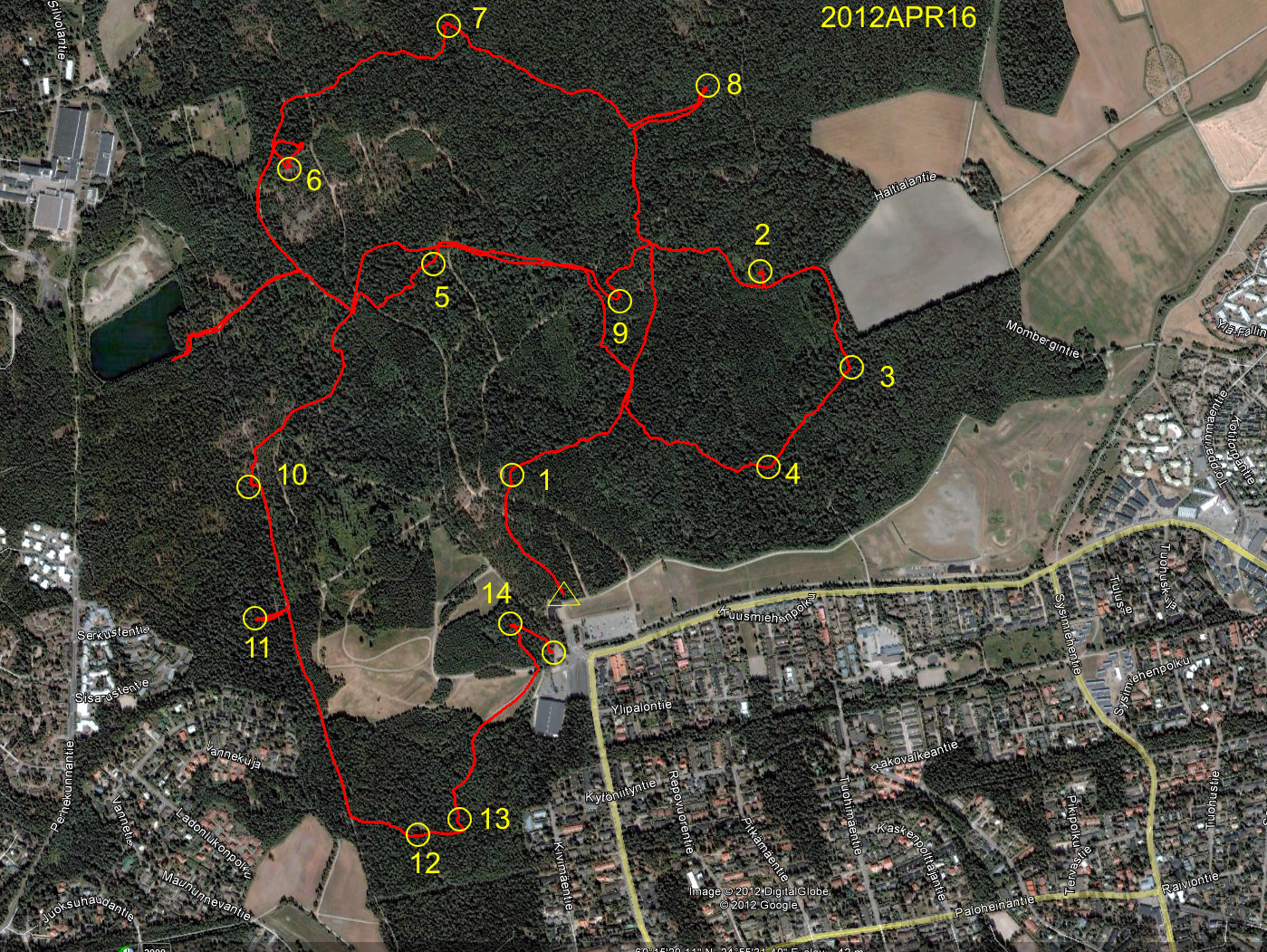
7k course. A big mistake, due to not identifying the right road correctly, between 5 and 6, which took about 17 minutes. Otherwise mostly ok..
I put on new 32mm wide tires on the road-bike and took it out for a spin. Sunny but windy weather with what seemed to be a headwind in every direction...
59.2km in 3h 21min (avg 17.6km/h)
(You have to zoom in or out to see the GPX-track. I'm not sure why that is happening)
First orienteering event of the year. 5 km course.
Hey I'm trying the OpenStreetMap plugin for wordpress. It should allow showing maps, places, and GPX-tracks in the blog.
They did have a critical bikeride in March already this year, but it was quite snowy and rainy so I didn't participate.
Today there were 130-140 participants.
Last year I think I participated in these events to raise awareness for bicycling four times: June, August, September, and October.
Here's some benchmark data for constructing the Voronoi diagram (or its dual, the Delaunay triangulation) for random point sites. Code for this benchmark is over here: https://github.com/aewallin/voronoi-benchmark
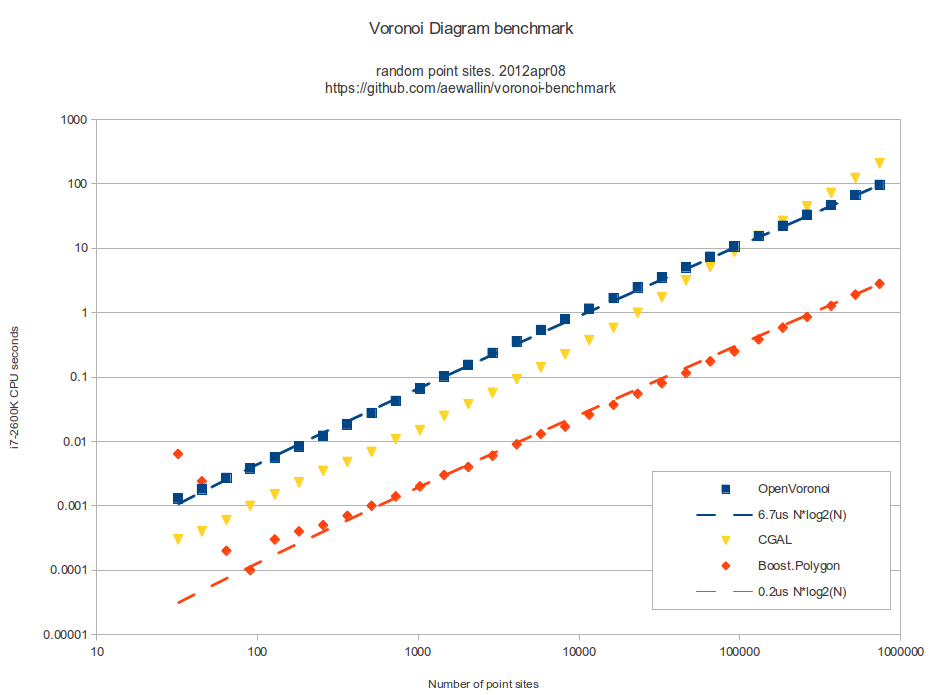
OpenVoronoi is my own effort using the incremental topology-oriented algorithm of Sugihara&Iri and Held. Floating-point coordinates with all sites falling within the unit-circle are used. Fast double-precision arithmetic is used for geometric predicates (e.g. "in-circle") during the incremental construction of the diagram, since the topology-oriented approach ensures that the algorithm finishes and produces an output graph regardless of errors in the geometric predicates. Quad-precision arithmetic is used for positioning vd-vertices. This benchmark runs in ca 7us*N*log2(N) time.
Boost.Polygon uses Fortune's sweepline algorithm. Only integer input coordinates are allowed, which ensures that geometric predicates can be computed exactly. Lazy arithmetic, where a high-precision slower number-type is used only when required, is used. This benchmark runs in ca 0.2us*N*log2(N) time.
CGAL uses exact geometric computation, which is slow but supposedly robust. The run-time gets worse with increasing problem-size and doesn't seem to fall on an O(N*log(N)) line.
Some thoughts:
I started working on arc-sites for OpenVoronoi. The first things required are an in_region(p) predicate and an apex_point(p) function. It is best to rapidly try out and visualize things in python/VTK first, before committing to slower coding and design in c++.
in_region(p) returns true if point p is inside the cone-of-influence of the arc site. Here the arc is defined by its start-point p1, end-point p2, center c, and a direction flag cw for indicating cw or ccw direction. This code will only work for arcs smaller than 180 degrees.
def arc_in_region(p1,p2,c,cw,p): if cw: return p.is_right(c,p1) and (not p.is_right(c,p2)) else: return (not p.is_right(c,p1)) and p.is_right(c,p2) |
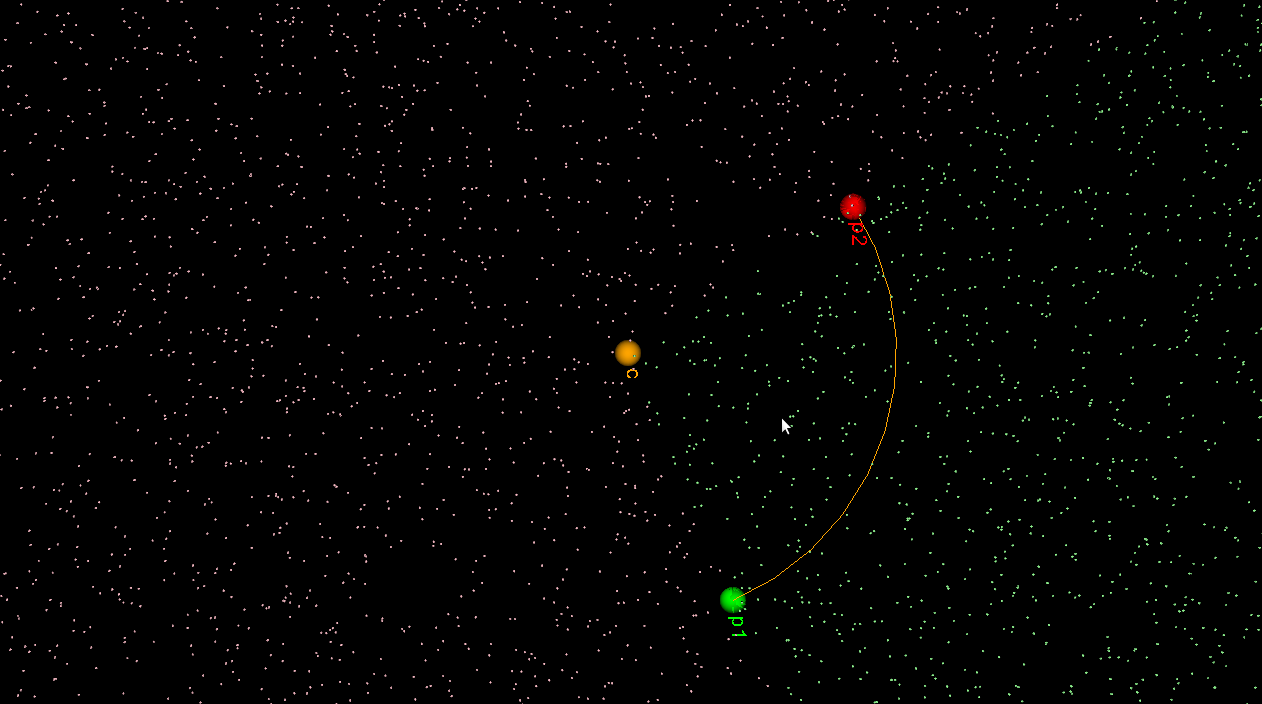
Here randomly chosen points are shown green if they are in-region and pink if they are not.
apex_point(p) returns the closest point to p on the arc. When p is not in the cone-of-influence either the start- or end-point of the arc is returned. This is useful in OpenVoronoi for calculating the minimum distance from p to any point on the arc-site, since this is given by (p-apex_point(p)).norm().
def closer_endpoint(p1,p2,p): if (p1-p).norm() < (p2-p).norm(): return p1 else: return p2 def projection_point(p1,p2,c1,cw,p): if p==c1: return p1 else: n = (p-c1) n.normalize() return c1 + (p1-c1).norm()*n def apex_point(p1,p2,c1,cw,p): if arc_in_region(p1,p2,c1,cw,p): return projection_point(p1,p2,c1,cw,p) else: return closer_endpoint(p1,p2,p) |
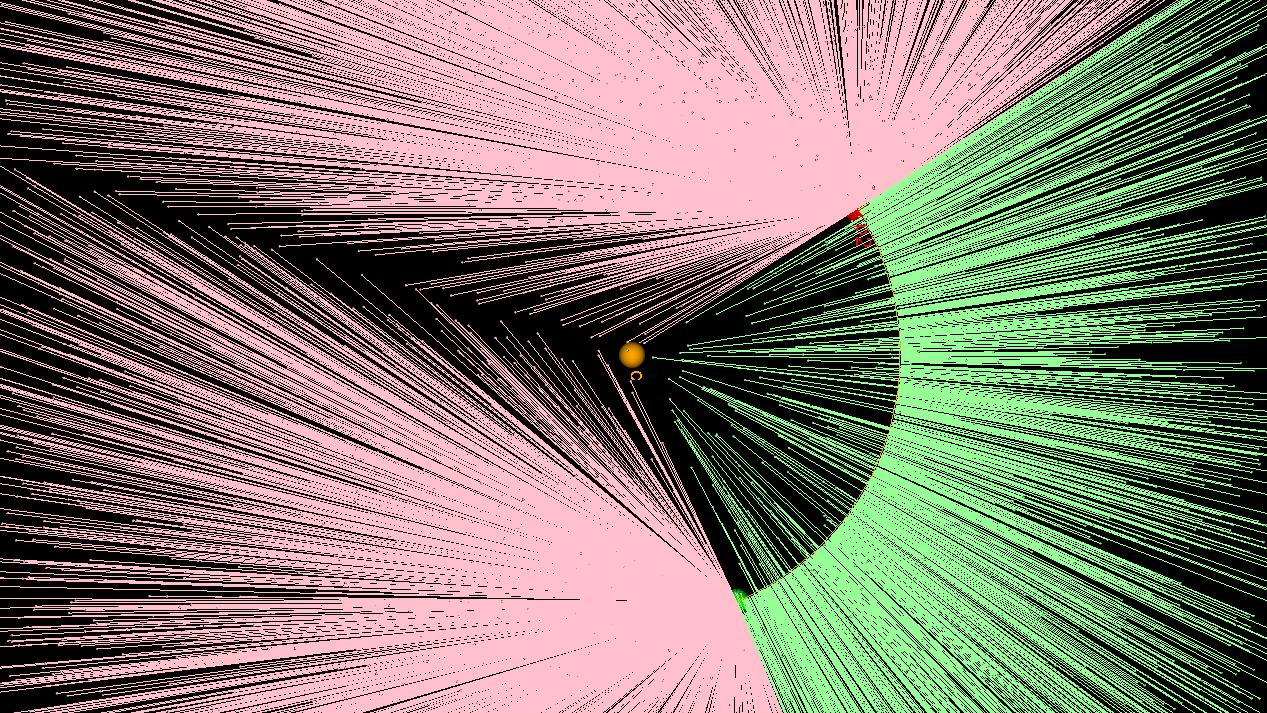
Here a line from a randomly chosen point p to its apex_point(p) has been drawn. Either the start- or end-point of the arc is the closest point to out-of-region points (pink), while a radially projected point on the arc-site is closest to in-region points (green).
The next thing required are working edge-parametrizations for the new type of voronoi-edges that will occur when we have arc-sites (arc/point, arc/line, and arc/arc).