Month: May 2009
Links - May 24, 2009
- Quantitative displacement measurement of a nanotube cantilever with nanometer accuracy using epifluorescence microscopy -
- Path integral formulation of your life. -
- Cloud Computing -
- Underdamped modes in a hydrodynamically coupled microparticle system -
- Compton Lecture: Steven Chu -
- Random Laser -
- Physics vs. Chemistry -
Fluorescent DNA
I'm testing an EMCCD camera. This is a video of fluorescently labeled DNA through a 100x epi-fluorescence microscope.
Or you can try a slightly better quality wmv-download (82 Mb)
Once we've had time to practice some more, it should look much cooler, something like these DNA-curtains, or DNA-ejection from bacteriophage lambda. But it's a start.
Also on a youtube near you: molecular motors, TIRFM, optical tweezers setup animation,
Links - May 17, 2009
- Herschel and Planck launched succesfully -
- A microfluidic mixing system for single-molecule measurements -
- Non-Blinking Quantum Dots -
- Trapping probability analysis of a DNA trap using electric and hydrodrag force fields in tapered microchannels -
- Optical tweezers with tips grown at the end of fibers by photopolymerization -
- Math on the Tube -
- Angle of Incidence = Music -
- What the Nighttime Sky Really Looks Like -
- You’ll Shoot Your Eye Out -
- Slo-Mo -
Mowing video moved
Jumpcut is closing, so I needed to move this video to youtube. This relates to my earlier posts here
http://www.anderswallin.net/2007/12/mowing-tactics/
and here
http://www.anderswallin.net/2007/06/an-emergent-spiral/
When I find time to work on this next, there are many ideas for improvements: How to specify only climb/conventional milling (allowing only the right or left side of the cutter to be used). Using a variable step length for the simulation. Simulating dynamics of the macing (controlling the tool with a trajectory generator with acceleration/speed limits etc). How to implement rapid feed between cutting moves? how to choose among many allowed starting points for the cut? Should this use an adaptive resolution model, like a quad-tree? How should G-code be output, a filter which outputs G-code within a specified tolerance of the simulated path would probably be best?
Uniform random points in a circle using polar coordinates
I need this seldom enough to forget how it's done - but then it's annoying to have to think/google for the solution again when I do need it... So I'll document here.
The task is to generate uniformly distributed numbers within a circle of radius R in the (x,y) plane. At first polar coordinates seems like a great idea, and the naive solution is to pick a radius r uniformly distributed in [0, R], and then an angle theta uniformly distributed in [0, 2pi]. BUT, you end up with an exess of points near the origin (0, 0)! This is wrong because if we look at a certain angle interval, say [theta, theta+dtheta], there needs to be more points generated further out (at large r), than close to zero. The radius must not be picked from a uniform distribution, but one that goes as
pdf_r = (2/R^2)*r
That's easy enough to do by calculating the inverse of the cumulative distribution, and we get for r:
r = R*sqrt( rand() )
where rand() is a uniform random number in [0, 1]. Here is a picture:
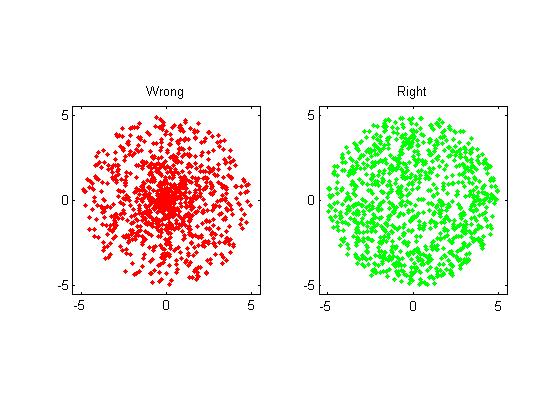
some matlab code here.
The thinking for generating random points on the surface of a sphere in 3D is very similar. If I get inspired I will do a post on that later, meanwhile you can go read these lecture notes.
Helsinki NIDays 2009
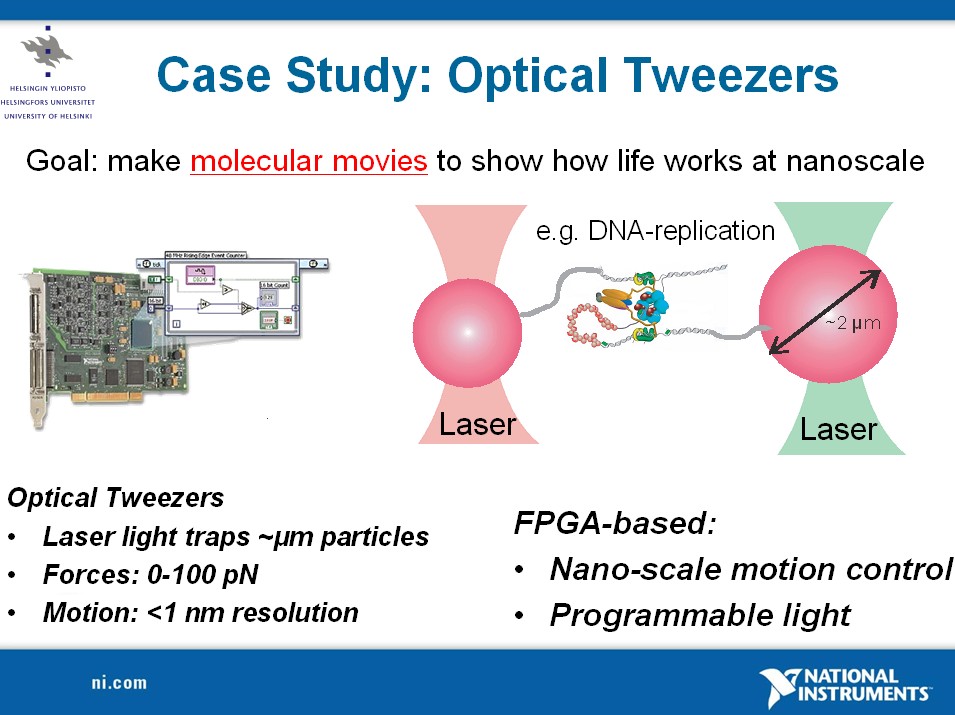
I presented one slide and a 3 minute video as a case-study during the keynote presentation at Helsinki NIDays 2009 this morning.
Links - May 10, 2009
- Control at the nanoscale: Smallness, strangeness and sophistication -
- 13,500 Sing “Hey Jude” in Trafalgar Square -
- Desktop 3-axis parallel kinematic milling machine -
- High rotation speed of single molecular microcrystals in an optical trap with elliptically polarized light -
- 05/04/09 PHD comic: 'Your Computer Desktop' -
ThinkPad T-series Trio
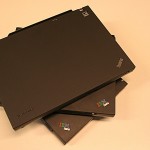
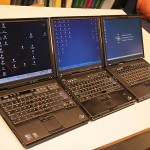
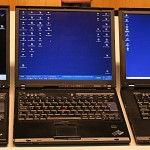
Left: T40, Middle: T60, Right T500. We have a T61 in the lab also but it didn't show up for the family photo. The T60 is mine. Compared to the T40, the only things I miss are the red and blue stripes on the mouse-keys 🙂 On the T500 there are lots of things that would be nice: Built-in webcam, built-in 3G, FireWire, and a HDMI-port. But there's also a lot of keyboard flex on the T500 compared to the older models.
The T400 would still be a sensible choice if I decide to upgrade (althougn I'm not thrilled by going from a 1400x1050 screen to 1440x900). If I win on the lottery any time soon I'll go with an X301.
Testing an optical force-clamp
Here a DNA-molecule is being stretched between two optically trapped polystyrene micron-sized beads. We're using an FPGA-based real-time controller for steering the upper trap. It's programmed with a PI-loop which aims to keep the force acting on the lower bead constant. Around 10s into the video we switch on the feedback-loop and we see the actual force on the bead rise to the set-point.